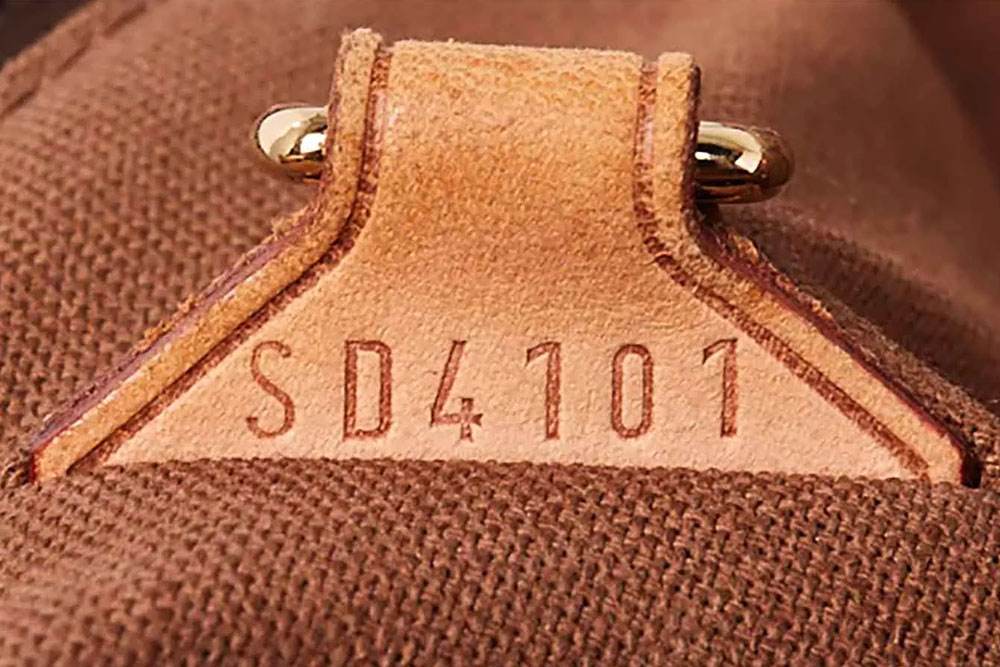
For decades, the Louis Vuitton date code has been a cornerstone of authentication. To many buyers and sellers, it was the first—and sometimes only—thing they looked for to determine if a bag was real. A quick peek inside a pocket, a deciphering of two letters and four numbers, and a sigh of relief. This little stamped marking was a secret handshake among LV enthusiasts, a powerful clue in the ongoing battle against counterfeiters.
But the ground has shifted. In a move that has rippled through the resale market, Louis Vuitton began phasing out date codes in 2021, replacing them with something far more high-tech: microchips.
So, what does this mean for the millions of bags produced before this change? Are date codes now useless? And how does one authenticate a newer bag that doesn’t have one? Understanding the evolution from date code to microchip is essential for anyone buying, selling, or collecting Louis Vuitton today. This guide will walk you through the entire history of the date code, explain how to read them, debunk common myths, and clarify why their role in authentication has fundamentally changed.
What is a Louis Vuitton Date Code?
First, let’s be clear about what a date code is and what it isn’t.
A Louis Vuitton date code is not a serial number. A serial number is unique to a single item. In contrast, a date code is a batch code that simply indicates when and where an item was manufactured. This means multiple bags can—and do—have the exact same date code if they were made in the same factory during the same week.
The primary purpose of a date code was for internal quality control. It allowed Louis Vuitton to track production batches and identify issues. For the public, however, it became a de facto tool for verifying the item’s claimed production era.
A date code tells you two things:
- The location of manufacture: Represented by two letters.
- The date of manufacture: Represented by numbers indicating the week/month and year.
Critically, a date code was never intended by Louis Vuitton to be a guarantee of authenticity for consumers. It was just one piece of a much larger puzzle that professional authenticators use.
The History and Evolution of LV Date Codes
The format of Louis Vuitton date codes was not static. It changed several times over the years, and knowing this timeline is crucial for proper interpretation.
Pre-1980s: The Wild West
Before the early 1980s, most Louis Vuitton items did not have date codes. The brand relied on other markers. Sometimes, the name was embossed in a particular way, or specific hardware was used. Authenticating pieces from this era requires deep historical knowledge and is not for amateurs.
Early to Mid-1980s: The First Numbers
In the early 1980s, Louis Vuitton introduced three or four-digit codes that represented the year and month of production. For example, a code like “836” would mean the item was made in the 6th month (June) of 1983. A four-digit code like “8412” would mean it was made in the 12th month (December) of 1984. The lack of factory letters made them simple but less informative.
Late 1980s: Letters Join the Party
Towards the end of the decade, the system was refined. Two letters were added to the end of the numerical code to indicate the factory location. The numbers still represented the year and month.
- Format: YYM(M)LL (Year, Month, Letters)
- Example: 8904.VI would mean the item was made in France (VI) in the 4th month (April) of 1989.
This system was also when French-made items sometimes had the letters appear before the numbers (e.g., A2 881), which can confuse people.
1990 to 2006: The Modern Format Begins
In 1990, Louis Vuitton overhauled the system into the format most people are familiar with today. The letters representing the factory code moved to the front, and the numbers were rearranged.
- Format: LL MYMY (Letters, Month, Year, Month, Year)
- Example: SP1928
- SP = Factory in France
- 1 and 2 = The month (12th month, or December)
- 9 and 8 = The year (1998)
- Interpretation: Made in France in December of 1998.
2007 to March 2021: The Week-Based System
In 2007, the system was tweaked one last time. The logic changed from representing the month to representing the week of the year.
- Format: LL WYWY (Letters, Week, Year, Week, Year)
- Example: FL4188
- FL = Factory in France (or USA, as this code was used in both)
- 4 and 8 = The week (48th week of the year)
- 1 and 8 = The year (2018)
- Interpretation: Made in France or the USA during the 48th week of 2018.
This is the system that remained in place until date codes were retired. Any bag with a date code from this era must follow this format.
How to Find and Read a Date Code
Locating a date code can feel like a treasure hunt. Louis Vuitton places them in discreet, often hard-to-reach locations. This was done to be unobtrusive, but it can make authentication challenging.
Common Locations for Date Codes:
- On a small leather tab: Stitched into an interior seam, often inside a pocket.
- Stamped directly onto the lining: This is common in bags with Alcantara or microfiber interiors. The stamping can fade over time, making it nearly illegible.
- Under the flap: In some wallet or clutch styles.
- On the exterior: For some items, like certain belts, the date code is stamped on the underside.
- Inside pockets: This is the most common placement. You often have to pull the pocket lining inside-out to find it.
Reading a Date Code: A Practical Example
Let’s say you find a Neverfull bag with the date code SD3179.
- Break it down: SD 3 1 7 9
- Identify the factory code: SD corresponds to a factory in France or the USA. (The model of the bag often helps narrow this down).
- Identify the year: The second and fourth digits are 1 and 9, so the year is 2019.
- Identify the week: The first and third digits are 3 and 7, so it was made in the 37th week of the year.
- Conclusion: The bag was manufactured in the USA or France during the 37th week of 2019.
This information is then cross-referenced. Does the “Made in…” stamp on the bag match the country of the date code? Does the bag model (Neverfull) exist in 2019? If the date code was SD3172, indicating 2012, but the bag was a model not released until 2015, that’s a huge red flag.
Why Date Codes Are No Longer a Reliable Authenticity Marker
For years, counterfeiters struggled to replicate date codes correctly. They would use the wrong font, an invalid factory code, or a date that didn’t make sense. But those days are over.
The Rise of the “Superfake”
Modern counterfeiters have mastered date codes. They not only replicate the font and stamping perfectly, but they also use logically correct codes. They will look up a real date code from a real bag and use it on their fakes. They know that a “Made in Spain” bag needs a Spanish factory code (like CA, LO, GI) and will use one that corresponds to a valid week and year.
This means that a perfect date code proves nothing. A fake bag can have a “correct” date code, and a real bag can have a faded or hard-to-read one. Relying solely on the date code for authenticity verification is one of the most common mistakes a buyer can make.
Other Date Code Misconceptions
- Myth: Every LV item has a date code.
- Fact: Items made before the 1980s, or items with linings that have been replaced, may not have one. Also, some small leather goods or accessories simply never did.
- Myth: A missing date code means it’s fake.
- Fact: Not necessarily. As mentioned, older items don’t have them. On bags with Alcantara lining, the code can completely rub off with use, which is very common.
- Myth: The “Made in…” stamp must be in the same country as the date code.
- Fact: This is usually true, but there are exceptions. Sometimes, parts are made in one country and assembled in another. However, a “Made in France” stamp paired with a “Made in USA” date code (SD, FH, LA) is a definite sign of a fake.
Given these issues, professional authenticators have always treated date codes as just one checkpoint among many. As our clients know from our detailed process (and as our Reviews show), we look at everything: hardware, stitching, materials, font, and overall construction. The date code was a helpful hint, but never the final word.
The New Era: RFID Microchips (Post-March 2021)
Sensing the diminishing reliability of date codes and seeking better inventory control, Louis Vuitton made a significant change. Starting in March 2021, the brand began embedding small Radio Frequency Identification (RFID) microchips into their bags and accessories.
What are these Microchips?
These are tiny, passive RFID chips that are sewn into the lining or structure of the item. They are invisible to the naked eye and cannot be felt. They are “passive,” meaning they don’t have a battery or transmit a signal on their own. They can only be activated and read by a specific scanner, much like the chip in your credit card.
What Information Do They Hold?
Contrary to popular belief, the chip does not contain the owner’s personal information. It holds data about the item itself:
- The exact model number.
- The materials used.
- The production date and location.
- The item’s journey through the supply chain.
Louis Vuitton employees can scan the chip with a special device to pull up this information instantly.
Why the Switch?
- Counterfeit Prevention: A date code can be copied. An encrypted, embedded RFID chip is vastly more difficult to replicate and embed correctly.
- Inventory Management: It allows LV to track products from factory to boutique with perfect accuracy.
- Repair and Service: When you bring a bag in for repair, they can scan it to confirm its authenticity and production history instantly.
How Microchips Impact the Authentication Process
The introduction of microchips has been a game-changer for the second-hand market.
The Challenge for Authenticators
The general public cannot read these chips. You need a specialized scanner and the right software to access the encrypted data. Some phone apps claim to be able to detect the chips, but they can’t read the crucial LV-specific information.
This means that for bags made after March 2021, a key piece of evidence is hidden from view. However, it does not make authentication impossible. It simply shifts the focus.
Authentication in the Microchip Era
Since we cannot rely on scanning the chip, we must double down on all the other physical attributes of the item. Professional authenticators like ProAuthenticators now put even more weight on:
- Material Quality: Does the canvas have the correct texture, sheen, and rigidity?
- Hardware Analysis: Is the weight, finish, and engraving of the zipper pulls and rivets correct?
- Stitch Count and Quality: Is the stitching per inch accurate for that model? Is the thread color correct?
- Font and Stamping: Is the “Louis Vuitton Paris” heat stamp perfectly aligned, spaced, and debossed?
In a way, this change has separated the amateurs from the experts. Someone who relied only on date codes is now lost when authenticating a 2022 bag. An expert who has always focused on the craftsmanship of the bag can continue their work with high accuracy.
The chip’s presence (or lack thereof) is now a data point itself. If someone is selling a bag they claim is from 2023 and it has a date code, we know it’s fake. If a bag is claimed to be from 2019 and has no date code (but also no chip), that is also a red flag.
What This Means for You as a Buyer or Seller
If you are buying a pre-2021 LV item:
- The date code is still a useful piece of information, but treat it with suspicion.
- Use it to check for inconsistencies. Does the code match the “Made in” stamp? Does the year make sense for the bag’s style?
- Do not accept the date code as final proof of authenticity. A perfect code means very little.
If you are buying a post-2021 LV item:
- Do not panic if there is no date code. There shouldn’t be one.
- Do not try to find the microchip. You won’t see it, and you could damage the bag trying.
- Because you cannot verify the chip, third-party authentication is more important than ever. You are relying entirely on the physical characteristics of the bag.
If you are selling an LV item:
- Be prepared to educate your buyers. Many people still don’t know about the switch to microchips and may wrongly accuse you of selling a fake if they can’t find a date code on a new bag.
- Investing in a certificate of authenticity can help bridge this knowledge gap and give your buyers the confidence to purchase. Our Services & Pricing page outlines options that can add significant value and trust to your listing.
Conclusion: The End of an Era, The Start of Another
The Louis Vuitton date code served the community well for over 40 years. It was a tangible clue that empowered buyers and gave them a starting point for verification. But its time as a reliable marker has passed. Counterfeiters adapted, and so Louis Vuitton evolved.
Today, the authentication landscape is more complex. For vintage and pre-owned bags from 1980-2021, the date code remains a historical footnote—a piece of the puzzle, but not the whole picture. For new bags, the invisible microchip has made expert, physical inspection the only reliable path to certainty.
Whether your bag has a date code, a microchip, or neither, the principles of good authentication remain the same. It requires a deep knowledge of the brand’s history, materials, and craftsmanship. Don’t let a few letters and numbers give you a false sense of security. Trust the details, and when in doubt, trust an expert.
Louis Vuitton Authentication made easy!
You are unsure if you are looking at an authentic or fake LV? We offer the quickest and the most accurate way to get it authenticated for your peace of mind.
Authenticate Now