The thrill of finding a pre-loved Louis Vuitton bag at a great price is hard to beat. Whether you are scouring online marketplaces, visiting consignment shops, or browsing estate sales, the hunt is part of the fun. However, that excitement often comes with a nagging question: “Is it real?” In an effort to save time or money, many buyers turn to Google, forums, and YouTube videos to authenticate the bag themselves. While these resources can be helpful, they are often incomplete, outdated, or misinterpreted.
Self-authentication is a risky endeavor. The luxury resale market is flooded with “super fakes”—counterfeit bags so sophisticated that they mimic the look, feel, and even the smell of the real thing. Relying on a few quick tips you found online can lead to disastrous financial mistakes. Identifying a genuine Louis Vuitton piece requires more than just a checklist; it demands deep knowledge of materials, production history, and manufacturing techniques. This guide explores the most common traps people fall into when trying to authenticate LV bags on their own and how you can avoid them.
The Illusion of Expertise
We all want to believe we have a sharp eye. When you read a guide that says, “Look for the date code,” it feels empowering. You check the bag, find the code, and feel a rush of relief. But authentication is rarely that black and white. Louis Vuitton has produced millions of bags over more than a century, across different countries and factories. Standards have changed, materials have evolved, and exceptions to the rules are plentiful.
When you self-authenticate, you are often looking at a bag in isolation. You lack the context of comparing it to thousands of other verified authentic pieces from the same era. You are also fighting against counterfeiters who read the exact same guides you do. If a blog post points out a flaw in fake bags, you can bet the counterfeiters are fixing that flaw in their next batch. This cat-and-mouse game means that amateur knowledge is almost always a step behind.
Mistake #1: The Date Code Trap
By far the most common mistake people make is relying entirely on the date code. There is a widespread myth that the date code is a serial number that proves authenticity. This is simply not true.
Codes Are Not Unique
A date code only tells you where and when a bag was made. It does not identify a specific, unique item. Thousands of bags can share the exact same date code. Finding a valid code does not mean the bag is real; it just means the counterfeiter knew which numbers to stamp.
Counterfeiters Know the Formula
Decoding a date code is simple math. If the code suggests the bag was made in France in the 42nd week of 2018, a counterfeiter can easily replicate that. Modern super fakes have perfectly formatted date codes that match the “Made in” stamp on the bag. If you stop your inspection once you see a valid code, you are playing right into their hands.
Missing Codes Don’t Mean Fake
On the flip side, many authentic bags—especially vintage ones or those with Alcantara lining—have date codes that have faded or rubbed off over time. Bags made before the early 1980s never had date codes to begin with. Many novice buyers pass on genuine vintage treasures because they can’t find a code, assuming it must be fake.
Mistake #2: Judging a Bag by Its Box
Psychology plays a huge role in deception. Counterfeiters know that if they can make the buying experience feel authentic, you are less likely to scrutinize the product itself. This leads to the dangerous mistake of trusting the packaging and “paperwork.”
The “Full Set” Fallacy
You see a listing that includes the orange Louis Vuitton box, the dust bag, the care booklet, and even a receipt. Your brain immediately signals “legit.” But you must remember: you are buying the bag, not the box. It is incredibly easy to buy authentic empty boxes and dust bags online and pair them with a fake bag. Furthermore, counterfeiters now manufacture high-quality fake packaging that looks convincing from a distance.
The Receipt Myth
A receipt is just a piece of paper. It is the easiest thing to forge. Super fakes often come with receipts that feature correct store addresses, sales associate names, and realistic pricing. Never assume a bag is real just because the seller has a receipt. Unless you can verify the transaction with the store directly (which is often impossible due to privacy laws), the paper trail is meaningless.
Mistake #3: Misunderstanding “Perfect” Stitching
One of the old adages of authentication is that “Louis Vuitton stitching is always perfect.” While LV craftsmanship is impeccable, “perfect” does not mean “machine-like.”
The Human Element
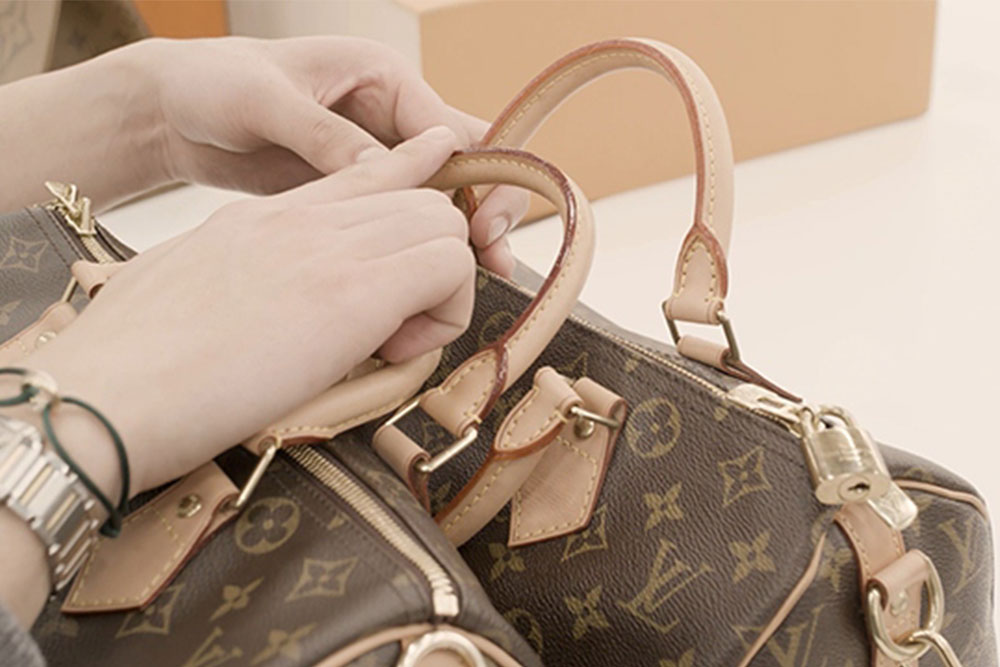
Louis Vuitton bags are hand-finished. This means there will be slight variations in stitch tension or angle. A completely rigid, mathematically perfect line of stitching is often a sign of a machine-made fake. Authentic stitching has a distinct aesthetic—it is slightly angled, almost like a cascade.
Counting Stitches
Some self-authenticators obsess over counting stitches, believing that a Speedy handle tab must always have exactly five stitches. While there are standards, these can vary by era and model. A bag from 1995 might have a different stitch count than one from 2023. If you apply modern rules to a vintage bag, or vice versa, you will likely make an incorrect judgment.
Mistake #4: The “Upside-Down” Monogram Panic
Every day, someone looks at their new Speedy or Keepall, sees the “LV” logos are upside down on the back, and panics. This is a classic example of how a lack of construction knowledge leads to false alarms.
Continuous Canvas Construction
Many iconic Louis Vuitton styles are made from one continuous piece of canvas that wraps from the front, under the bottom, and up the back. Because of this design, the monogram will naturally be right-side up on the front and upside down on the back. This is not a flaw; it is a hallmark of authentic construction for those specific models.
Pattern Alignment nuance
Buyers also often look for perfectly mirrored patterns on every single seam. While LV strives for symmetry, it is not always geometrically possible on every curved edge or corner. There are acceptable tolerances for alignment. Rejecting a bag because the monogram is shifted by a single millimeter is often a mistake. Conversely, failing to notice a major alignment issue because you are too focused on the date code is equally dangerous.
Mistake #5: Comparing to Online Photos
In the digital age, it is natural to open two tabs: one with the bag you want to buy, and one with a stock photo from the Louis Vuitton website. You switch back and forth, looking for differences. This method is fraught with errors.
Lighting and Color
Professional studio lighting makes canvas look brighter and hardware look shinier than it does in real life. A photo taken in a seller’s dim living room will never match the official product shot. Variations in color tone, sheen, and texture are almost impossible to judge accurately across different photos.
Production Changes
Louis Vuitton constantly updates its materials. The canvas used in 2010 is different from the canvas used in 2020. The hardware finish has shifted from shiny brass to matte or antique finishes depending on the collection. If you compare a 2015 bag to a 2024 stock photo, you will see differences. These are not signs of a fake; they are signs of production evolution. Unless you know the specific history of material changes, spot-checking against random photos is ineffective.
Mistake #6: Relying on Subjective Senses
“It feels cheap.” “It smells like chemicals.” “It feels too light.”
These are common complaints, but they are subjective and unreliable.
The Weight Debate
Many people assume authentic bags are heavy. However, vintage bags can feel lighter due to wear, and newer bags might feel lighter due to changes in hardware alloys. A fake bag can be weighted to feel substantial. Weight alone proves nothing.
The Smell Test
While a strong chemical “fufu” smell is a bad sign, the absence of it doesn’t make a bag real. A used bag will smell like its previous owner—perfume, smoke, or storage mustiness. These odors can mask the scent of the materials. Furthermore, high-end fakes use real leather trim, so they will smell like leather.
The Consequence of Error
The risks of self-authentication are not just academic; they hit your wallet. If you mistakenly identify a fake bag as real, you could lose thousands of dollars with little recourse. PayPal and credit card companies often require proof from a professional authenticator to process a dispute. Your personal opinion that “the stitching looks wrong” is rarely enough to get your money back.
Conversely, if you mistakenly identify a real bag as fake, you might miss out on a dream purchase or falsely accuse an honest seller, damaging your reputation in the community. The stress and uncertainty of second-guessing yourself take the joy out of the luxury experience.
The Role of Professional Authentication
Given the complexity of modern counterfeits and the depth of knowledge required to spot them, professional authentication is no longer a luxury—it is a necessity. This is where experts bridge the gap.
At ProAuthenticators, we do not rely on guesswork or Google searches. We use a systematic, evidence-based approach. Our team has analyzed thousands of bags, creating a mental and digital library of what “authentic” looks like for every era and model.
We go beyond the basics:
- Microscopic Analysis: We look at the grain of the canvas and the finish of the hardware at a magnification level that reveals details invisible to the naked eye.
- Font Forensics: We analyze the specific typography of the heat stamps, looking for kerning and font weight consistency that matches the exact production year.
- Database Verification: We cross-reference date codes and factory stamps against known production schedules to ensure the bag’s history aligns with reality.
For a small fee, you receive a definitive answer. This service acts as an insurance policy for your purchase. If you are looking to buy or sell, having a certificate of authenticity adds value and trust to the transaction. You can explore our services and pricing to find a package that suits your needs, whether you need a quick answer or a detailed certificate.
Real Stories, Real Savings
We hear from clients every day who thought they could spot a fake, only to be surprised by our findings. The “super fakes” are designed specifically to fool the confident amateur.
One client recently sent us photos of a Neonoe she purchased. She had checked the date code, the stitching, and the receipt. Everything looked perfect to her. However, our analysts noticed a minute discrepancy in the font of the “Made in” stamp that was inconsistent with the declared factory code. That single, tiny detail unraveled the whole deception. She was able to use our documentation to return the bag and get a full refund.
Another client found a vintage Keepall at a yard sale for a steal but was convinced it was fake because the zipper didn’t say “Louis Vuitton.” Our team identified the zipper as a genuine Eclair zipper used by LV in the early 80s, confirming he had found a genuine treasure worth hundreds of dollars.
These stories highlight why expert eyes are critical. You can read more about our clients’ experiences on our reviews page. Their testimonials illustrate the peace of mind that comes from knowing the truth about your luxury items.
Conclusion: Protect Your Investment
Self-authenticating a Louis Vuitton bag is like trying to diagnose a medical condition using only a search engine. You might get it right sometimes, but the risk of a misdiagnosis is high, and the consequences can be costly.
The counterfeit market is evolving rapidly. Fakes are getting better, and the old “tells” are disappearing. Common mistakes—like trusting receipts, obsessing over date codes, or misjudging vintage quirks—are easy to make when you don’t have professional training.
Don’t let a mistake turn your dream bag into a nightmare. Recognize the limits of DIY checking and trust the experts to handle the heavy lifting. Whether you are buying, selling, or just curious about a piece in your closet, professional authentication is the smartest way to protect your investment and ensure you are carrying authentic history, not a hollow imitation.
Louis Vuitton Authentication made easy!
You are unsure if you are looking at an authentic or fake LV? We offer the quickest and the most accurate way to get it authenticated for your peace of mind.
Authenticate Now