You’ve found it—the Louis Vuitton bag you’ve been dreaming of, listed on a resale site for a tempting price. It looks perfect in the photos, and the seller swears it’s authentic. But in the world of luxury resale, looks can be deceiving. The market is saturated with counterfeits, many of which are so skillfully made that they can easily fool an untrained eye. Before you invest your hard-earned money, you need to know what to look for.
Learning the top signs of a fake Louis Vuitton bag is the first line of defense against being scammed. While professional authentication remains the only way to be 100% certain, arming yourself with knowledge can help you weed out obvious fakes and identify red flags that warrant a second look.
This guide will walk you through the key areas where counterfeiters often fail, from the feel of the material to the font on a tiny heat stamp. We will provide actionable tips to help you inspect a bag and understand why even with this knowledge, an expert opinion is your best asset.
The Foundation of Authenticity: Materials and Craftsmanship
Louis Vuitton built its legacy on unparalleled quality. The materials they use are designed to last for generations. This is often the first and most obvious place where fakes fall short.
The Iconic Coated Canvas
Louis Vuitton’s Monogram, Damier Ebene, and Damier Azur patterns are not made of leather. They are crafted from a proprietary coated canvas that the brand has perfected over a century. It is durable, waterproof, and has a distinct texture.
- Texture and Feel: Authentic LV canvas has a unique pebbled or grainy texture. It should feel supple and substantial, not stiff or plastic-y. Many fakes use a cheaper vinyl material that feels slick, smooth, or has an oily sheen. Run your hand over the surface; an authentic bag has a tangible grain, whereas a fake often feels flat.
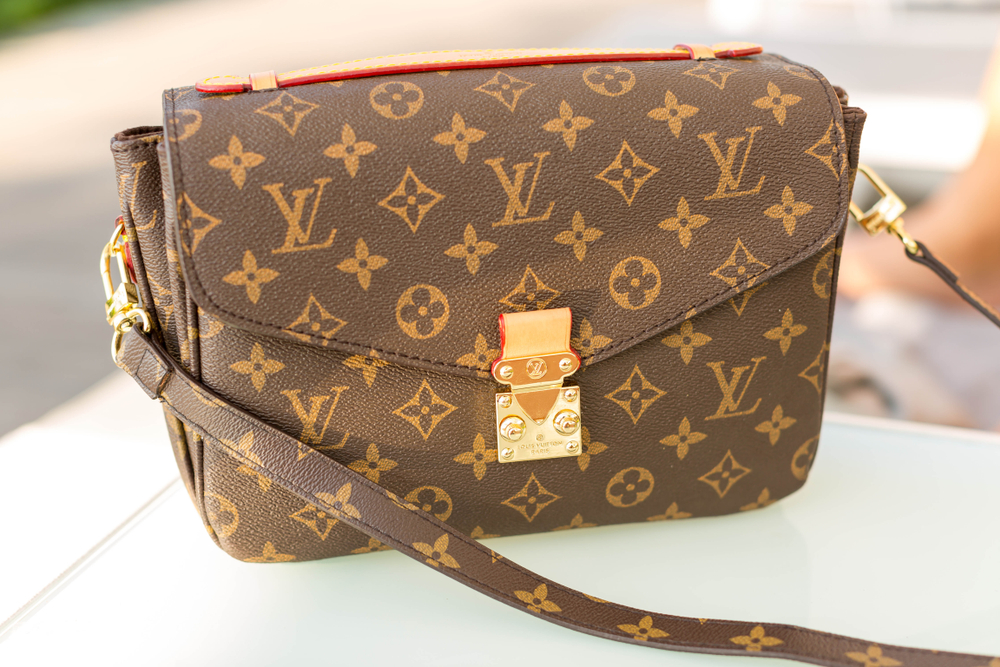
- Color and Hue: The colors on authentic canvas are specific and consistent. For example, the Monogram canvas has a warm, caramel-brown background, not a dull, ashy, or greenish-brown. The Damier Ebene check pattern should be a rich, deep brown, not a flat, muted color. Counterfeiters often struggle to replicate these exact hues.
- The Smell Test: An authentic new Louis Vuitton bag has a distinct, clean smell—a mix of the treated canvas and leather trim. It is not an unpleasant odor. Fakes, on the other hand, often reek of chemicals, strong glue, or plastic. If the bag has a pungent, artificial smell, it’s a significant red flag.
Vachetta Leather: The Signature of Aging
Many Louis Vuitton bags feature trim and handles made from Vachetta leather. This is a natural, untreated cowhide leather that is a hallmark of the brand.
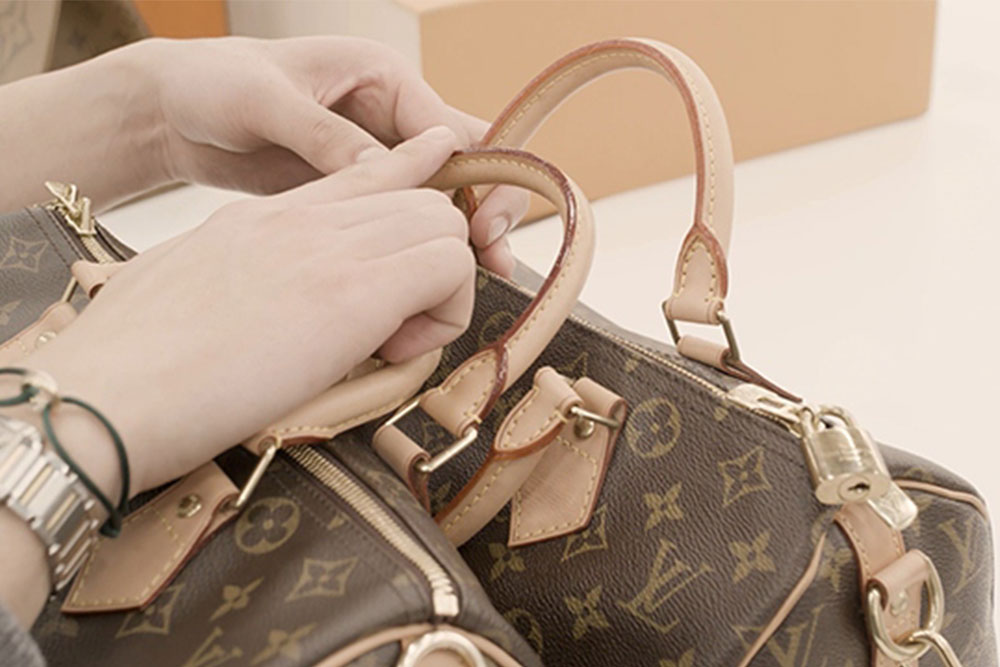
- Initial Appearance: Brand new Vachetta leather is a very light, pale beige color with a smooth, almost matte finish. It should not look shiny, waxy, or feel sticky. Fakes often use lower-quality leather that has been coated or treated, giving it an unnatural sheen.
- The Patina Process: The most beautiful characteristic of Vachetta is its ability to patina. Over time, exposure to sunlight, air, and the oils from your hands will cause the leather to darken into a beautiful, rich honey or amber color. A “vintage” bag with pristine, pale white handles is highly suspicious. Counterfeiters sometimes try to fake this patina by dyeing the leather, resulting in a color that looks flat, uneven, or has an orange tint rather than a deep, natural honey.
- Red Edging: The edges of Vachetta leather straps and tabs are sealed with a reddish-burgundy glaze. On an authentic bag, this glazing is applied neatly and precisely. It should feel smooth and slightly flexible. On fakes, the glaze is often a bright, garish red—like nail polish. It may look sloppy, thick, chipped, or feel sticky and plastic-like.
The Devil in the Details: Stitching and Construction
Louis Vuitton’s reputation is built on meticulous, handcrafted quality. The stitching is a testament to this, and it’s one of the hardest details for counterfeiters to replicate perfectly.
Consistency is Key
Look closely at the stitches, particularly on the handle tabs (chaps) and leather trim.
- Stitch Count: For many iconic models, Louis Vuitton uses a consistent number of stitches in specific places. For example, the leather tabs that hold the handle rings on a Speedy or Keepall typically have five stitches across the top. While this can vary slightly, a bag with three or seven stitches in that spot warrants suspicion.
- Angle and Uniformity: Authentic LV stitching is often done at a slight angle, not perfectly straight. Every stitch should be the same length and evenly spaced. The overall look is one of absolute neatness and control. Fake bags often have messy, uneven stitching, with some stitches being longer or shorter than others. You may also see double-stitching or back-and-forth stitching where it shouldn’t be.
- Thread Color and Quality: The thread used on Monogram and Damier canvas bags is typically a mustard or honey-yellow color, not a bright, lemony yellow. It’s often coated in a special resin or beeswax to make it durable and water-resistant, which can give it a subtle sheen. Fakes may use a cheaper, brighter thread that can fray easily.
Pattern Alignment and Symmetry
Louis Vuitton takes great care in how its iconic patterns are placed on a bag.
- Symmetry: On classic, symmetrical bags like the Speedy and Keepall, the pattern should be a mirror image from side to side. For instance, if the pattern starts with a half-circle motif on the far left seam, it should end with the same half-circle motif on the far right seam.
- Continuous Canvas: Many LV bags, including the Speedy, are made from a single, continuous piece of canvas that wraps around the bag. This means that on one side of the bag the LV logos will be right-side up, and on the other side, they will be upside down. If you see a Speedy where the logos are right-side up on both the front and back, it is a definite fake.
- The “No Cut-Off LV” Rule (with a caveat): Generally, Louis Vuitton avoids cutting through the “LV” logo at a seam. They will cut through the floral or diamond motifs, but the logo itself is usually kept whole. However, this is not an absolute rule. On certain complex bag designs or smaller items, it is sometimes unavoidable. Relying solely on this point can be misleading, but on a simple, classic bag, a cut-off logo is a major warning sign.
Hardware: The Weight and Precision of Luxury
Hardware is one of the most expensive components to replicate well, making it a common giveaway for fakes.
Material and Weight
Authentic Louis Vuitton hardware is typically made of solid brass, sometimes plated with other metals.
- Feel the Weight: It should feel heavy, solid, and cool to the touch. Counterfeit hardware is often made from plastic coated with a metallic finish or a cheap, lightweight metal alloy. If the zipper pulls, clasps, or rings feel light and flimsy, be cautious.
- Color and Finish: Authentic gold-tone hardware has a rich, deep hue that is not overly yellow or brassy. It should have a subtle luster, not a cheap, mirror-like shine. Fakes often use a plating that looks too yellow and chips or flakes away easily, revealing the cheap metal underneath.
Engravings and Fonts
The markings on the hardware are a critical point of inspection.
- Crispness and Depth: The “Louis Vuitton” or “LV” engravings on zipper pulls, rivets, and D-rings should be clean, crisp, and precise. The letters should be well-defined and easy to read. On fakes, the engravings often appear blurry, shallow, or have a “bubbly” look from poor laser etching.
- The Font: The font used is very specific. The “O” should be very round, almost a perfect circle. The “L” has a noticeably short tail. The two “T”s in “VUITTON” are often very close together, almost touching (“TT”). Counterfeiters often use a generic font that is too tall or skinny.
- Zipper Brands: Louis Vuitton has used several zipper manufacturers over the years, including Eclair, Talon, and YKK. More recently, they produce their own with “LV” branding. An expert authenticator knows which zipper brand is appropriate for a specific bag model and year. A brand new bag with a vintage Talon zipper, for instance, would be a red flag.
Stamps and Codes: The Bag’s Inner ID
The internal stamps and codes are like the bag’s birth certificate, providing information about its origin. Counterfeiters know this and try hard to replicate them, but they often make mistakes.
The Heat Stamp
Inside every bag, you will find a leather tab with a heat stamp that says “LOUIS VUITTON PARIS made in [Country].”
- The Font is Everything: As with the hardware, the font here is crucial. In addition to the round “O” and short-tailed “L,” look at the “R” in the registered trademark symbol (®). It should be a very distinct shape. The letters should be perfectly spaced—not too close together and not too far apart.
- Stamp Quality: The stamp should be clearly and evenly impressed into the leather. It should not be so deep that it cuts into the leather, nor so faint that it is hard to read. Gold or colored stamping should be crisp, with no bleeding into the surrounding leather.
- Country of Origin: Louis Vuitton bags are made in France, Spain, the USA, Italy, Germany, and Switzerland. The “Made in” stamp must correspond to the factory code on the date code.
The Date Code (and Its Limitations)
For items made before March 2021, the date code was a key authentication tool. It is a combination of letters and numbers indicating where and when the item was made.
- Finding the Code: The hunt for the date code can be tricky. It can be found stamped on a small leather tab inside a pocket, along a seam, or directly onto the interior lining.
- Decoding It: Typically, two letters represent the factory location, and four numbers represent the month/year or week/year of production. For example, “FL0138” would indicate a bag made in France in the 3rd week of 2018.
- The Critical Flaw: A correct-looking date code does NOT guarantee authenticity. Counterfeiters can easily look up valid code formats and stamp them into a fake bag. The real test is whether the date code makes sense for the bag’s style and matches the “Made in” stamp. For example, a bag style that was discontinued in 2010 should not have a 2018 date code.
The Post-2021 Microchip
Louis Vuitton has replaced date codes in new items with embedded RFID microchips. These chips are invisible and cannot be read by a standard smartphone app. While third-party authenticators can detect the presence of a chip, only LV can read its encrypted data. The absence of a date code in a bag manufactured after March 2021 is normal, but the presence of one could be a red flag.
When in Doubt, Turn to the Professionals
You can read guides and watch videos for hours, but the truth is that counterfeiters are always improving. A “super fake” might get 95% of the details right, and it takes a highly trained expert to spot that final 5% of error.
Relying on self-authentication is a huge gamble.
- The Risk of Overlooking Details: You might be so excited about a potential purchase that you experience confirmation bias, overlooking a subtle flaw because you want the bag to be real.
- The Need for a Holistic View: An authenticator doesn’t just check off a list. They evaluate how all the elements work together. A perfect heat stamp on a bag with sloppy stitching is a sign of a fake. An expert’s experience allows them to see the full picture.
- The Value of a Certificate: If you buy a bag that turns out to be fake, getting your money back from a platform like eBay or PayPal often requires proof. A certificate of non-authenticity from a reputable service is the evidence you need to win your dispute.
Professional authentication is an affordable and essential part of the buying process. You can see how accessible peace of mind is by looking into services and pricing from dedicated experts. Their entire job is to know the difference between a real authentic Louis Vuitton bag and a fake one. The small fee is a powerful insurance policy against a four-figure mistake. Don’t just take our word for it; seeing the reviews from countless other buyers and sellers shows how critical this service has become in the modern resale market.
Final Verdict: Trust, But Verify with Experts
Learning how to spot fake Louis Vuitton signs is an empowering skill for any luxury enthusiast. It allows you to shop smarter, ask the right questions, and avoid the most obvious scams. Use this guide as a tool to perform your initial inspections and build your knowledge base.
However, never let your own inspection be the final word. The sophistication of fakes has made professional authentication a non-negotiable step. Whether you are buying your first LV or selling a piece from your collection, engaging an expert is the only way to transact with total confidence. By combining your own vigilance with professional verification, you can ensure that your luxury purchase is a source of joy, not a costly regret.
Louis Vuitton Authentication made easy!
You are unsure if you are looking at an authentic or fake LV? We offer the quickest and the most accurate way to get it authenticated for your peace of mind.
Authenticate Now