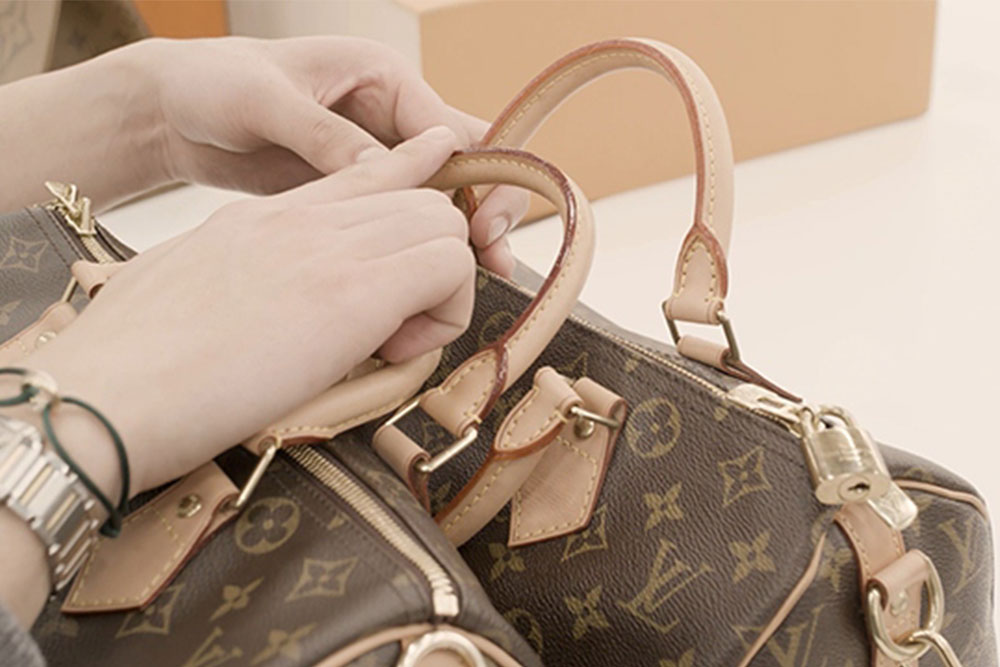
When authenticating a pre-loved Louis Vuitton bag, it’s easy to get lost in the canvas, the stitching, or the date code. While those elements are crucial, counterfeiters often stumble on the details they think you will overlook: the hardware. The zippers, rivets, and clasps on an authentic Louis Vuitton bag are more than just functional components; they are pieces of jewelry crafted with precision and quality. Forgers can mimic a pattern, but replicating the exact weight, sheen, and feel of genuine LV hardware is a significant challenge.
The hardware is where the luxury of a Louis Vuitton bag truly shines. The satisfying click of a lock, the smooth glide of a zipper, and the deep, clean engraving on a rivet are all hallmarks of the brand’s commitment to quality. Counterfeit manufacturers, focused on volume and low cost, simply cannot match this level of detail. They use cheaper metals, sloppy engravings, and poorly plated finishes that chip and tarnish.
Learning to identify authentic Louis Vuitton hardware is one of the most powerful skills you can develop as a savvy buyer in the second-hand market. This guide will walk you through the key hardware elements, providing the specific details you need to examine. We will cover zippers, locks, clasps, rivets, and D-rings, teaching you how to tell the real from the replica.
1. Zippers: The First Line of Defense
The zipper is one of the most-used parts of any handbag, and Louis Vuitton ensures theirs can withstand a lifetime of use. LV does not manufacture its own zippers; instead, it partners with high-end hardware producers. This is a critical piece of information that many authenticators use.
Zipper Brands and Markings
For decades, Louis Vuitton has used zippers from several reputable brands. Knowing these names can help you spot a fake immediately.
- Eclair: Found on many vintage bags from the 1970s and early 1980s. The logo is a simple, block-letter “ECLAIR.”
- Talon: Another common brand on vintage pieces.
- YKK: While YKK is a common zipper brand found on everything from jeans to backpacks, LV has used them. However, they are typically found on specific styles and eras. A YKK zipper pull will have the brand name engraved on the side of the slider, not usually on the pull itself.
- Lampo: A high-end Italian zipper manufacturer. You will often find “LAMPO” engraved on the underside of the zipper slider on many modern LV bags. This is one of the most common and reliable indicators of authenticity on newer styles.
If a zipper has no branding at all, or a generic, unknown brand name, it is a major red flag. Counterfeiters often use cheap, unbranded zippers that feel gritty and snag easily. An authentic LV zipper should always glide smoothly and effortlessly.
The Zipper Pull: Shape and Finish
The zipper pull itself is a key identifier. Louis Vuitton has used various designs over the years, but they all share common characteristics.
- Material and Weight: Authentic zipper pulls are made of solid brass or a similar high-quality metal alloy. They should have a noticeable weight and feel substantial in your hand. Fakes are often made from cheaper metals or even plastic coated in a metallic finish. They feel light and flimsy.
- Finish: Genuine LV hardware has a smooth, rich golden sheen. It’s not overly shiny or brassy yellow like many fakes. On older bags, the brass may develop a natural patina or show some tarnish, but it should not chip or flake. If you see silver-colored base metal peeking through a peeling gold finish, you are looking at a counterfeit.
- Engraving: Most LV zipper pulls have “LV” or “Louis Vuitton” engraved on them. The engraving should be crisp, deep, and perfectly executed. On fakes, the engraving is often shallow, blurry, or has uneven spacing. The letters may look “puffy” or poorly defined. For the iconic LV circle logo on some pulls, the circle should be perfectly round, and the letters should be sharp.
2. Rivets and Studs: The Unsung Heroes
Rivets and studs might seem like minor details, but they are incredibly difficult for counterfeiters to get right. These small pieces of hardware hold straps and handles in place, so their quality is paramount to the bag’s durability.
Engraving Quality is Everything
Almost every rivet on a Louis Vuitton bag will be engraved with “Louis Vuitton” or the “LV” logo. This is a prime spot to catch a fake.
- Font and Spacing: The font used on authentic rivets is specific. The “O” in “Vuitton” should be perfectly round, not oval. The two “T”s in “Vuitton” should be very close together, almost touching. Counterfeiters often use a generic font with oval “O”s and more space between the “T”s.
- Depth and Clarity: On a real bag, the engraving is deep, sharp, and easy to read, even on a tiny rivet head. Run your finger over it; you should be able to feel the indentations clearly. Fake engravings are often shallow, looking more like they were lightly laser-etched or poorly stamped onto the surface. They can be blurry or have fuzzy edges.
- Placement: The engraving should be perfectly centered on the rivet head. Fakes often have off-center or crooked text.
Shape and Profile
Look at the rivet from the side. An authentic LV rivet has a slightly domed or rounded shape, not a completely flat top. Counterfeit rivets are often too flat or, conversely, too pointed and dome-like. The back of the rivet (the part inside the bag) should also be finished properly and may have a small indentation or marking.
3. The Padlock and Keys: An Iconic Duo
The shiny brass padlock that accompanies bags like the Speedy and Keepall is an iconic Louis Vuitton symbol. It’s also one of the most scrutinized pieces of hardware during an authentication.
The Lock: Weight, Shape, and Engraving
An authentic LV padlock feels heavy and solid. It’s made of solid brass. Fake locks are often lighter and feel hollow.
- Engraving: The front of the lock features the “LV” logo inside a circle. The logo should be clear and well-defined. On the back, you will find the text “LOUIS VUITTON” and “PARIS” below it. Again, look for the round “O”s and the nearly touching “T”s. Below that, it should say “MADE IN FRANCE” in smaller capital letters. The engraving on fakes is often shallow and uses the wrong font.
- The Bottom of the Lock: Flip the lock over. You will see a number that corresponds to the number on the keys. You will also see a U-shaped or V-shaped line engraved at the bottom. This line should be clean and precise. Fakes often have messy or absent lines. The number stamp on fakes can also be in the wrong font or size.
- Finish: An authentic lock has a brushed finish on the sides and a shinier finish on the front and back. It is never a mirror-like, cheap shine. It will tarnish naturally over time, but it will not flake.
The Keys: Shape and Markings
The keys are just as important as the lock.
- Shape: Authentic LV keys have a distinct shape. The main barrel is cylindrical, and the head of the key is rounded with a defined cutout. Many fakes have a flat, generic-looking key shape.
- The Number Stamp: The number on the key must match the number on the bottom of the padlock. The font of this number should be crisp and uniform.
- Material: Like the lock, the keys are made of solid brass and have a good weight to them. They shouldn’t feel light or cheap.
The experience of using the lock is also a tell. An authentic lock has a smooth, satisfying mechanism. Fake locks often feel gritty, get stuck, or don’t close securely.
4. Clasps, Clips, and D-Rongs: The Connectors
The hardware that connects straps to the bag—clasps, clips, and D-rings—is under constant stress. Louis Vuitton engineers these pieces for strength and longevity.
Material and Plating
All connective hardware should be made of solid brass, which is then plated. This is why you will never see chipping on an authentic bag. The gold finish may wear away over time on high-contact points, revealing the brass underneath, but it will not flake off like paint. Counterfeiters use cheap alloys that are plated with a thin layer of gold-colored material. This coating easily chips, revealing a silvery, pot-metal base. This is an instant giveaway of a fake.
The “LV” Stamped Logo
Clasps and clips often feature a small, stamped “LV” logo.
- Clarity: This stamp should be incredibly crisp and clear. You should be able to see the distinct “L” and “V” even though they are tiny. On fakes, this stamp is often blurry, looks like a messy blob, or is missing entirely.
- Placement: The logo should be perfectly centered on the designated area of the hardware.
- Feel: Run your finger over the logo. It should be a clean indentation, not a raised or poorly defined mark.
Functionality of Clasps
The clasps on straps, like those on a Pochette Metis or Multi Pochette Accessoires, have a spring-loaded mechanism. This mechanism should be smooth and have good tension. It should snap back into place securely. Fake clasps often have weak springs, feel gritty when opened and closed, or have a visible gap when shut. They don’t inspire confidence.
D-Rings: The Anchor Point
D-rings are the metal loops that clasps attach to. On an authentic LV bag, these rings are thick, solid, and have no seams. Counterfeit D-rings are often thinner, feel lighter, and may have a visible seam where the metal was joined together. Look at the shape as well. A real D-ring has a flat side and a perfectly rounded “D” curve. Fakes can be irregularly shaped or have flattened curves.
Our clients often share their relief after we help them verify these small but crucial details. You can read their stories on our reviews page and see how identifying these hardware flaws saved them from purchasing a counterfeit.
5. Specialty Hardware: The S-Lock and Beyond
Some Louis Vuitton bags feature unique, signature hardware that requires special attention.
The S-Lock on the Pochette Metis
The S-lock on the Pochette Metis is a complex and beautiful piece of hardware inspired by historic LV trunks.
- Mechanism: The two pushers on the side should press in smoothly and simultaneously to release the arm. The arm should then pop up without resistance. When you close it, the arm should click back into place with a crisp, satisfying sound. Fake S-locks are notoriously clunky. The pushers can be stiff, the arm may not pop up correctly, or it won’t close securely.
- Engraving: The lock plate is engraved with “LOUIS VUITTON” in a circle, and the arm itself has “LOUIS VUITTON PARIS” engraved on it. All the rules about font, spacing, and clarity apply here. The engraving should be immaculate.
- Screws: The S-lock is attached to the bag with small, specialized screws. Authentic LV screws have a unique star or six-pointed shape. Counterfeiters almost always use simple Phillips-head or flat-head screws because the custom ones are too expensive to replicate. This is one of the quickest and most definitive ways to spot a fake Pochette Metis.
Other Unique Hardware
Bags like the Capucines feature unique hardware where the LV initials are integrated into the structure. The quality of the metal, the polish, and the mechanism are all designed to be flawless. Any stiffness, imperfection, or cheap feel is a sign of a fake.
A Final Checklist for Hardware Authentication
When you are inspecting a pre-owned Louis Vuitton bag, run through this mental checklist for every piece of hardware you see:
- Weight and Feel: Does it feel solid and substantial, or light and cheap?
- Color and Finish: Is it a rich, golden tone, or a brassy, cheap yellow? Is the finish smooth or peeling?
- Engraving: Is the text crisp, deep, and centered? Are the “O”s round and the “T”s almost touching?
- Functionality: Do zippers glide smoothly? Do clasps click securely? Does the lock mechanism feel well-made?
- Branding: Are the correct brand names (like Lampo) present on the zipper? Are the “LV” stamps clear?
- Screws: Are they the correct star shape, or generic Phillips-head screws?
When in Doubt, Don’t Risk It
Hardware is a language. To the untrained eye, it’s just metal. To a professional authenticator, it tells a story of craftsmanship, quality, and origin. While this guide gives you the tools to become a more educated buyer, the truth is that “superfakes” are getting better every day. They may get 90% of the details right, hoping you won’t notice the 10% they got wrong.
That’s where professional authentication becomes your safety net. An expert has seen thousands of bags—both real and fake. They have a trained eye for the subtle differences in font size, hardware sheen, and engraving depth that can only be learned through experience.
Don’t let the excitement of finding a good deal cloud your judgment. A fake Louis Vuitton bag is not a bargain; it’s a waste of money. If you have any doubt about the hardware—or any other part of a bag—it’s time to call in a professional. Our team at ProAuthenticators can give you a definitive answer. Check out our services and pricing for affordable peace of mind. Protect your investment and ensure the bag you carry is a genuine piece of Louis Vuitton history.
Louis Vuitton Authentication made easy!
You are unsure if you are looking at an authentic or fake LV? We offer the quickest and the most accurate way to get it authenticated for your peace of mind.
Authenticate Now