In the meticulous world of Louis Vuitton authentication, the loudest clues are often the quietest. While many focus on the canvas pattern or the hardware’s shine, the true story of a bag’s origin is often told in the thread. The stitching on a Louis Vuitton bag is more than just a means of holding it together; it is a signature of the brand’s century-old commitment to artisanal craftsmanship. It is a language of precision, consistency, and quality that counterfeiters consistently fail to speak fluently.
A machine can replicate a monogram print, and a factory can churn out shiny, gold-colored hardware. But recreating the exact tension, angle, and rhythm of an LV artisan’s stitch is incredibly difficult. Forgers rely on speed and volume, using automated processes that produce a sterile, lifeless seam. An authentic bag, by contrast, bears the subtle fingerprint of a human hand—a mark of quality that manifests as near-perfect, yet character-rich, stitching.
Learning to read the story told by the stitches is one of the most powerful skills an aspiring authenticator can develop. It allows you to see past the surface and evaluate the very bones of the bag. This guide will walk you through the critical aspects of Louis Vuitton stitching, from thread quality and color to stitch count and tension, showing you how these tiny details can definitively separate a masterpiece from a cheap imitation.
1. Thread Quality and Color: The Foundation of the Stitch
Before a single stitch is made, the choice of thread sets the stage for quality. Louis Vuitton uses a specific type of high-quality thread designed for strength, durability, and a distinct aesthetic.
The Thread Itself: Strength and Sheen
- Authentic Thread: Louis Vuitton uses a heavy-duty, bonded thread that is incredibly strong. It’s often a linen thread coated in a special resin or wax. This coating not only strengthens the thread but also gives it a subtle, low-lustre sheen and helps it glide smoothly through the tough layers of canvas and leather. The thread feels robust and slightly coarse to the touch.
- Counterfeit Thread: Fakes almost always use a cheaper, standard-quality cotton or polyester thread. This thread is thinner, weaker, and often has a flat, matte appearance with no sheen. Sometimes, it can look fuzzy or start to fray even on a “new” bag. It lacks the substantial, durable feel of the real thing.
The Signature Mustard Yellow Color
The color of the thread is one of the most iconic and easily identifiable features.
- Authentic Color: The thread used on Monogram Canvas and Damier Ebene bags is a distinct mustard or dandelion yellow. It’s a warm, golden hue that beautifully complements the brown tones of the canvas and the patina of the Vachetta leather. It is never a bright, lemon yellow or a pale, beige color.
- Counterfeit Color: This is where many fakes get it spectacularly wrong. Counterfeiters often use thread that is far too bright—a garish, neon yellow that looks cheap and clashes with the canvas. Others might use a thread that is too pale or has an orange or brownish tint. The inability to match the exact dye lot of the signature LV yellow is a common downfall for replicas. When you see a thread color that seems “off” or too loud, trust your instincts.
On other materials, like Damier Azur, the thread is typically a creamy beige to match the trim. On Epi leather, the thread color is meticulously matched to the color of the leather itself. Any color mismatch on these bags is an immediate red flag.
2. Stitch Count (SPI): The Rhythm of Authenticity
One of the most quantitative measures of stitching quality is the “Stitches Per Inch” (SPI). Louis Vuitton artisans are trained to maintain a consistent SPI on specific parts of the bag. This consistency is a hallmark of their skill.
What to Look For in Stitch Count
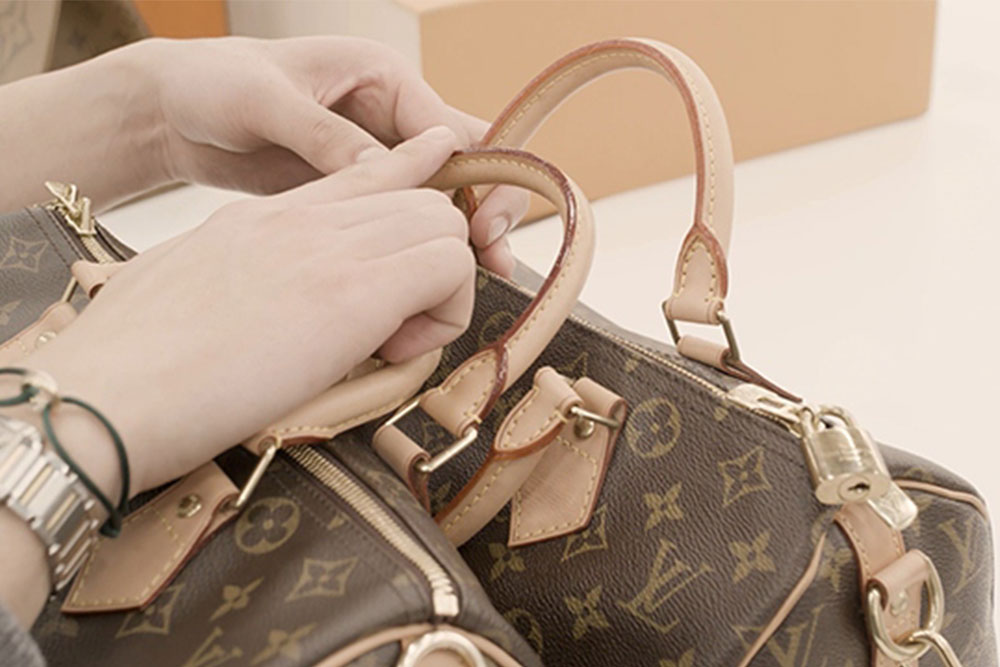
- Authentic Stitch Count: While the exact SPI can vary slightly by model and year, it is always consistent on a single bag. For example, the small leather tabs that anchor the handle hardware (the “chapes”) often have a specific number of stitches. On a Speedy, the chappe typically has five stitches running across the top. If you see a bag with four stitches, or six, or an uneven number on different chapes, it is a significant red flag.
- Consistency is Key: Look at the stitching along a handle strap or down a seam. The stitches should be evenly spaced, creating a pleasing, uniform rhythm. An authentic LV bag will not have stitches that are suddenly crowded together in one area and spaced far apart in another.
- Counterfeit Stitch Count: Counterfeiters either don’t know or don’t care about these specific stitch counts. They are focused on speed. You will often find fakes with the wrong number of stitches on the handle tabs. More commonly, their SPI is inconsistent. Their automated machines may be poorly calibrated, resulting in stitching that varies in length and spacing along a single seam. A low SPI (fewer, longer stitches) is often a sign of a rush job intended to save time and thread.
Counting the stitches on key components like handle tabs, zipper pulls, and pocket flaps is a simple yet incredibly effective authentication technique.
3. Stitch Angle and Direction: The Subtle Slant
The angle of the stitches is a subtle but critical detail that counterfeiters almost always overlook. The stitches on an authentic Louis Vuitton bag are not perfectly horizontal. They have a slight, consistent upward angle.
The Hallmarks of an Authentic Slant
- Slight Upward Angle: When looking at a line of stitching from left to right, each individual stitch should have a slight slant, pointing slightly upwards. The pattern should look like this: ////. This is a natural result of the type of sewing machine and technique used by LV artisans. The angle should be consistent across the entire bag.
- No Horizontal Stitches: The stitches should not be perfectly straight and horizontal like this: —-. This “dead straight” stitch is often a sign of a lower-quality machine or technique used in counterfeit production.
- Counterfeit Inconsistency: Fakes display a wide range of stitching angle errors. Some have the dead-straight stitch mentioned above. Others have an angle that is too extreme or inconsistent, with some stitches slanting up and others slanting down. Some may even have a downward angle (\\\\), which is a definitive sign of a fake. The lack of a consistent, subtle, upward slant is a major indicator of inauthentic craftsmanship.
This detail requires you to look closely, but once you see it, you can’t unsee it. It is one of the most reliable indicators of a skilled hand versus a careless machine. The experiences shared by our clients, which you can read on our reviews page, often highlight how this small detail provided the clarity they needed to identify a fake.
4. Tension and Embedding: The Mark of a Master
Stitch tension refers to how tightly the thread is pulled, binding the materials together. Perfect tension is a delicate balance—too loose and the seam is weak; too tight and the material will pucker.
What Perfect Tension Looks Like
- Authentic Tension: On a real LV bag, the tension is perfect. The stitches lie neatly and are slightly embedded into the leather or canvas. You can see a small indentation or “channel” where the thread sits. This indicates that the stitch is secure and pulled with just the right amount of force. It creates a clean, durable seam that is both strong and beautiful.
- No Puckering or Loose Loops: The material around the stitches should be perfectly flat. There should be no bunching or puckering, which would indicate the tension is too tight. Conversely, there should be no loose loops of thread on either the front or the back of the seam, which would indicate the tension is too loose.
Common Counterfeit Tension Flaws
Counterfeiters struggle immensely with getting the tension right.
- Shallow, “Floating” Stitches: The most common flaw is insufficient tension. The stitches appear to “float” on the surface of the material rather than being slightly embedded. They look like they were just laid on top and could be easily snagged. This is a sign of a low-quality machine and a rushed process.
- Puckering and Bunching: In other cases, counterfeiters over-tighten the thread in an attempt to make the bag seem sturdy. This causes the leather or canvas along the seam to bunch up and pucker, creating an ugly, wrinkled appearance. This is especially noticeable on softer leathers.
- Messy Backstitching: Look at where a line of stitching begins and ends. LV artisans use a very neat, precise backstitch to lock the seam, often stitching back over the same holes. Counterfeiters are often sloppy, resulting in a messy tangle of thread at the start or end of a seam.
5. The Art of the Back-and-Forth Stitch on Handles
The handles of a Louis Vuitton bag are subjected to the most stress. The stitching here must be exceptionally robust. The point where the handle’s Vachetta leather is stitched to the hardware anchor is a key area for inspection.
- Authentic Handle Stitching: LV artisans use a time-consuming “saddle stitch” or a similar technique for this area. This involves passing two needles through the same hole from opposite directions, creating a locked stitch that is incredibly strong. Even if one thread breaks, the other will hold the seam together. This results in a very neat, angled, and durable seam.
- Counterfeit Handle Stitching: Fakes use a simple machine lockstitch. It’s fast, but it’s weak. If the top thread breaks, the entire seam can unravel. Visually, this machine stitching often looks less angled and less embedded than an authentic saddle stitch. It lacks the robust, handcrafted appearance of the real thing.
Your Stitching Authentication Checklist
When examining a bag, mentally run through this stitching checklist:
- Thread Color: Is it the signature LV mustard yellow (for Monogram/Damier Ebene) or a bright, cheap yellow?
- Stitch Count: Are there exactly five stitches on the Speedy’s handle tabs? Is the count consistent on all similar parts?
- Angle: Do the stitches have a slight, consistent upward slant (////), or are they straight (—-) or messy?
- Tension: Are the stitches slightly embedded in the material, or are they floating on top? Is the material puckering?
- Consistency: From stitch to stitch, seam to seam, is the quality uniform? Or are there areas of sloppiness?
Why Trust a Professional with the Details?
While this guide provides you with a powerful set of tools, the counterfeit industry is constantly evolving. The makers of “superfakes” are studying authentic bags and trying to improve their mimicry of details like stitching. They might get the color right but miss the angle, or get the stitch count right but fail on the tension.
Distinguishing between the subtle, acceptable variations of a handmade product and the clear errors of a counterfeit requires a depth of experience that comes from examining thousands of bags. An expert authenticator has a trained eye for the precise slant, the exact SPI for a specific model from a specific year, and the feel of a perfectly tensioned seam.
Don’t spend your money on a bag only to live with the nagging doubt that it might be a fake. The peace of mind that comes from a definitive authentication is invaluable. Our team at ProAuthenticators lives and breathes these details. We can give you a conclusive verdict on your bag’s authenticity, protecting your investment and your confidence. Visit our services and pricing page to see how easy and affordable it is to get an expert opinion. Your authentic Louis Vuitton bag deserves to be carried with absolute certainty.
Louis Vuitton Authentication made easy!
You are unsure if you are looking at an authentic or fake LV? We offer the quickest and the most accurate way to get it authenticated for your peace of mind.
Authenticate Now