Buying a luxury handbag is more than just a purchase; it’s an investment. Few brands hold their value quite like Louis Vuitton. From the iconic Speedy to the modern Neverfull, these bags are coveted worldwide. Unfortunately, this popularity comes with a massive downside: a flooded market of counterfeits.
For a beginner, telling the difference between a real gem and a high-quality replica can feel impossible. The “super fakes” of today are terrifyingly accurate, mimicking stitching, hardware, and even date codes with surprising precision. So, how do you ensure your hard-earned money is going toward the real deal?
This guide breaks down exactly how Louis Vuitton authentication works. We will walk you through the specific checkpoints experts use, the tools involved, and why relying on a professional eye is often the safest route. Whether you are looking to buy your first pre-loved piece or sell a cherished item from your collection, understanding this process is crucial.
Why Louis Vuitton Authentication Is Critical
The luxury resale market is booming. Platforms like eBay, Poshmark, and The RealReal are full of listings for “authentic Louis Vuitton” items. However, the responsibility of verification often falls on the buyer.
The Rise of “Super Fakes”
Ten years ago, spotting a fake was relatively easy. The leather felt like plastic, the logos were cut off clumsily, and the hardware was lightweight. Today, counterfeiters use real leather, oxidizing hardware, and sophisticated printing techniques. Without knowing the subtle nuances of Louis Vuitton authentication, you could easily spend thousands on a bag worth fifty dollars.
Protecting Your Investment
Authentic Louis Vuitton bags retain their value incredibly well. Some limited editions even appreciate over time. If you accidentally buy a counterfeit, that value drops to zero immediately. Learning how to authenticate Louis Vuitton protects your financial asset.
Legal and Ethical Implications
Selling counterfeit goods is illegal. If you unknowingly sell a fake bag, you could face platform bans, legal trouble, and a damaged reputation. Authentication isn’t just about peace of mind; it is about safety.
The Fundamentals of Authentication: What Experts Look For
Professional authentication is a holistic process. An expert doesn’t just look at one feature; they look at how all features work together. Here are the primary pillars of the process.
1. The Monogram and Pattern Alignment
The first thing most people notice is the canvas. Louis Vuitton uses a specific coated canvas that is incredibly durable.
- Symmetry is Key: On classic monogram pieces (like the Speedy or Keepall), the pattern should be symmetrical from side to side. If the pattern starts with a half-circle logo on the left, it should end with a similar half-circle on the right.
- Continuous Canvas: On many styles, the canvas is one continuous piece of fabric that wraps from the front to the back. This means the “LV” logos on the backside of the bag will be upside down. If the logos are right-side up on both sides of a Speedy, that is a major red flag.
- No Cut-Off Logos: While this isn’t a hard-and-fast rule for every single seam (especially on smaller leather goods or complex shapes), LV generally avoids cutting off the “LV” logo at the seams. They will often cut the floral motifs, but the brand logo itself is usually preserved.
2. The Stitching Quality
Louis Vuitton prides itself on perfection. The stitching is one of the hardest things for counterfeiters to replicate perfectly.
- Angle and Consistency: Authentic stitching usually has a slight angle to it, rather than just a straight line. Each stitch should be the same length.
- Thread Color: The thread is typically a mustard yellow on monogram canvas bags, not a bright, neon yellow. The thread is coated with a special beeswax to make it durable.
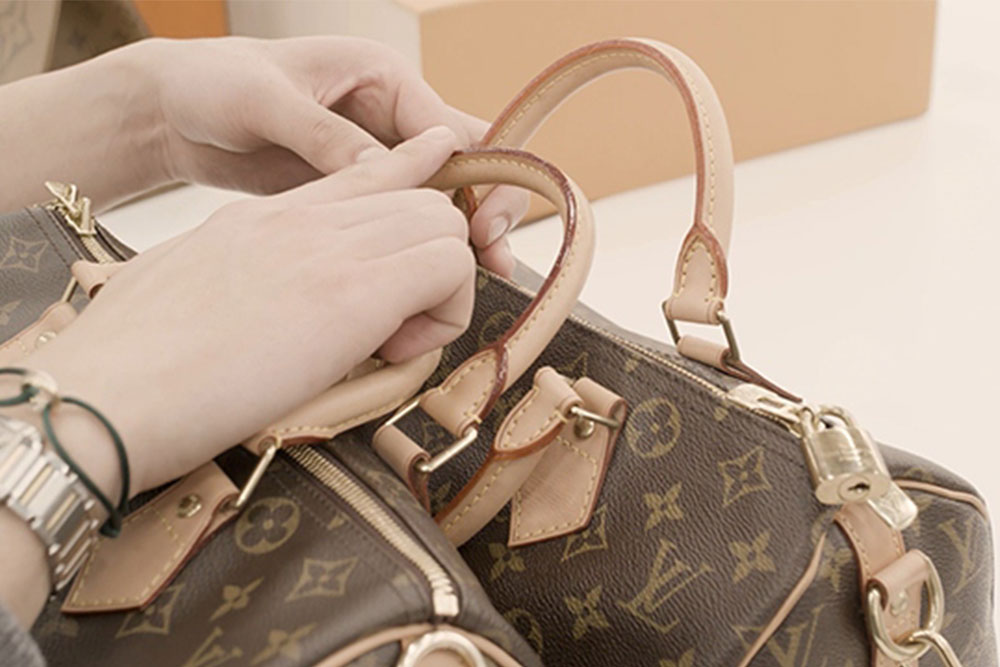
- Stitch Count: On certain iconic areas, like the tabs where handles attach, the stitch count is often consistent across authentic models. Experts know these specific counts by heart.
3. The Date Code (and Why It’s Tricky)
For decades, the date code was the holy grail of Louis Vuitton authentication. It is a series of letters and numbers that indicates where and when the bag was made.
- Deciphering the Code: Typically, the code consists of two letters (factory location) followed by four numbers (production date). For example, a code might indicate the bag was made in France in the 34th week of 2019.
- The Location: Finding the code can be a scavenger hunt. It might be embossed on a leather tab inside a pocket, stamped directly onto the lining, or hidden near a seam ring.
- The Limitation: Counterfeiters know how date codes work. They can stamp a valid-looking code into a fake bag. Just because a bag has a date code that “scans” correctly online does not mean the bag is authentic. Conversely, vintage bags might have faded codes, and brand new bags (post-March 2021) don’t have date codes at all—they use microchips.
4. Hardware and Engravings
Hardware is often where fakes fail. Authentic hardware is made of high-quality metals (usually brass) that feel heavy and cool to the touch.
- Engraving Crispness: The “Louis Vuitton” engraving on zippers, rivets, and clasps should be crisp, clear, and deep. Fakes often have laser etching that looks shallow or bubbly.
- The Font: The font used on the hardware is specific. The “O” in Louis Vuitton should be very round, almost a perfect circle. The “L” has a short tail. If the font looks tall or skinny, it’s likely a replica.
- Zippers: LV has used different zipper manufacturers over the years (Eclair, Talon, YKK, and their own hardware). Knowing which zipper belongs in which era is a key part of expert authentication.
Advanced Authentication Techniques
While the basics above can help you spot a bad fake, “super fakes” require a deeper dive. This is where professional knowledge separates the casual buyer from the expert authenticator.
Heat Stamps and Fonts
The “Louis Vuitton Paris Made in France” stamp (or Made in Spain, USA, Italy, etc.) is the fingerprint of the bag.
- Alignment: The stamp should be perfectly centered on the leather tab.
- Depth: It should be embossed evenly—not too deep, not too faint.
- Font Nuances: As mentioned with hardware, the font here is critical. The “R” leg usually meets the rest of the letter at a specific angle. The spacing between the letters must be uniform. Fakes often get the spacing wrong, making the words look squashed or stretched.
Material Analysis
Authenticators use their sense of touch and smell as much as their eyes.
- The Smell: Authentic canvas and leather have a distinct, clean smell. It smells like leather and chemicals used in the tanning process, but it is never overwhelming. Fakes often smell strongly of cheap glue, plastic, or harsh chemicals.
- The Texture: Monogram canvas has a pebbled texture. It should feel leathery and grainy, not slick or plastic-like. The leather trim (Vachetta) on new bags should be pale beige and feel smooth but not waxy. Vachetta is untreated leather, meaning it will darken (patina) over time with exposure to air and oils. If a “vintage” bag has brand-new, white leather handles, it’s suspicious.
Microchip Technology (RFID)
As of March 2021, Louis Vuitton began phasing out physical date codes in favor of embedded RFID microchips.
- How It Works: These chips are hidden inside the lining of the bag. They are not visible to the naked eye.
- Scanning: You cannot scan these with a standard phone app to get authentication data. The data is encrypted and only accessible by Louis Vuitton store employees with specific scanners.
- Verification: For third-party authenticators, verifying a microchip involves detecting its presence and ensuring the signal comes from the correct location in the bag. While they cannot read the encrypted LV data, confirming the chip’s existence in a post-2021 bag is a crucial step.
The Role of Professional Authentication Services
You might be thinking, “Can I just learn all this and do it myself?” While it is great to be informed, self-authentication is risky. The margin for error is high, and the financial stakes are significant. This is why professional services exist.
Why You Need a Second Opinion
Even seasoned collectors get duped. Confirmation bias is real; if you want the bag to be real, you might overlook a small flaw. A third-party authenticator offers an unbiased, objective analysis based on data and experience.
Services and Pricing
Professional authentication is surprisingly affordable compared to the cost of a luxury mistake. Services typically offer different tiers depending on how fast you need the result or if you need a formal certificate of authenticity for a dispute.
For reliable, expert verification, you can explore professional options that fit your needs. Check out ProAuthenticators services and pricing to see how accessible expert peace of mind can be. They specialize in Louis Vuitton, meaning their team looks at these specific bags all day, every day.
What Do You Get?
When you use a service like this, you aren’t just getting a “yes” or “no.”
- Expert Analysis: Your item is reviewed by human experts, often supported by AI technology.
- Documentation: You receive a certificate or statement. If you bought a fake on eBay or PayPal, this documentation is often required to win a dispute and get your money back.
- Speed: Many services offer turnaround times of under 24 hours, so you don’t have to wait long to know if your purchase is safe.
Common Myths About Louis Vuitton Authentication
There is a lot of misinformation online about how to authenticate Louis Vuitton. Let’s debunk a few common myths that could lead you astray.
Myth 1: “Authentic Bags Never Have Cut-Off Logos”
As mentioned earlier, this is false. While LV tries to avoid it, the structure of certain bags (like the Pallas or certain round coin purses) necessitates cutting into the monogram pattern. Do not assume a bag is fake solely because a flower is cut off at the seam.
Myth 2: “It Came with a Yellow Card, So It’s Real”
Louis Vuitton has never issued yellow authenticity cards. If your bag comes with a yellow card that says “Authenticity Card,” it is 100% a fake. LV bags come with a small cream-colored tag with the material name and a barcoded sticker, but never a credit-card-style authenticity card.
Myth 3: “The Date Code Says It Was Made in France, But the Stamp Says Made in USA”
This is actually a massive red flag, but the myth is that date codes and stamps don’t have to match. They absolutely do. The factory code letters in the date code must correspond to the country stamped on the exterior. For example, if the date code starts with “SD” (which can be USA or France depending on the year) and the bag says “Made in Spain,” something is wrong.
Myth 4: “Authentic Bags Have flawless Stitching Always”
While LV quality control is legendary, they are still handmade items. Occasionally, a stitch might be slightly imperfect. However, “imperfect” does not mean “sloppy.” Messy, fraying, or crooked stitching is a sign of a fake. But a microscopic variance in a single stitch does not automatically condemn a bag.
A Step-by-Step Guide to Inspecting a Bag Yourself
If you are in a consignment store or meeting a seller, follow this quick checklist to perform an initial inspection.
Step 1: The General Feel
Pick up the bag. Does it feel substantial? Authentic canvas is sturdy, not flimsy. The hardware should have some weight to it. If the bag feels like a toy, walk away.
Step 2: Check the Hardware
Look closely at the zipper pulls and clasps. Is the gold tone too yellow or brassy? Does the metal look like plastic painted gold? Check the zipper action—it should be smooth, with a little bit of resistance, not loose and rattling.
Step 3: Inspect the Stamp
Find the “Louis Vuitton Paris” heat stamp. Is it perfectly centered? Is the gold leafing (if present) crisp, or is it bleeding into the leather? Remember the font rules: round O, short L.
Step 4: Locate the Date Code (Pre-2021)
Find the date code. Google the factory letters. If the code says the bag was made in 2015 but the style wasn’t released until 2018, it’s a fake.
Step 5: Look at the Packaging (If Available)
Fakes often come with dust bags that are too stiff, have the wrong color font (dark brown instead of dark blue), or have “Louis Vuitton” written in the wrong font. Authentic dust bags are soft, 100% cotton, and high quality.
Why Authentication Matters for Sellers
If you are selling, you might think authentication is the buyer’s problem. It isn’t.
Building Trust
Buyers are skeptical. If you can provide proof of authentication from a reputable source, your item becomes instantly more attractive. You can often command a higher price because you have removed the risk for the buyer.
Avoiding Returns and Scams
Scammers sometimes target sellers by buying a real bag and claiming they received a fake to get a refund. having a documented authentication certificate before you ship proves the condition and authenticity of the item you sent, protecting you in disputes.
The Verdict: Trust But Verify
Learning how Louis Vuitton authentication works is a fascinating journey into the world of luxury craftsmanship. It deepens your appreciation for the brand and the skill that goes into making these bags.
However, the sophistication of modern counterfeits means that relying solely on DIY guides is risky. Whether you are a seasoned collector or a first-time buyer, the smartest play is to combine your own knowledge with professional verification.
When in doubt, reach out to experts. Use resources like the link provided earlier to get a professional opinion. It is a small price to pay to ensure your luxury investment is truly authentic Louis Vuitton.
By staying informed and vigilant, you keep the luxury market safe and ensure that the beautiful bag on your arm is the real masterpiece it claims to be.
Louis Vuitton Authentication made easy!
You are unsure if you are looking at an authentic or fake LV? We offer the quickest and the most accurate way to get it authenticated for your peace of mind.
Authenticate Now