Louis Vuitton jewelry authentication starts with the exact model, material, size, colorway, and release. Bracelets, necklaces, earrings, rings, brooches, and fashion-jewelry pieces use different construction, closures, markings, and decorative techniques.
ProAuthenticators reviews Louis Vuitton jewelry through photos as part of our brand-specific service. If you need to authenticate an LV bracelet or another piece, begin with our service choices and prepare sharp close-ups from every side.
Identify the jewelry model
A Louis Vuitton motif may appear across several jewelry lines, but the proportions and hardware can differ. We compare the item’s stated name, type, dimensions, finish, stones or enamel, chain or band construction, and included components with a compatible reference.
Fashion jewelry also changes across seasons, and older pieces can show finish wear that current product photos do not. Authentication should account for the release and condition rather than expect every piece to look new.
What experts examine on LV jewelry
Overall design and proportions
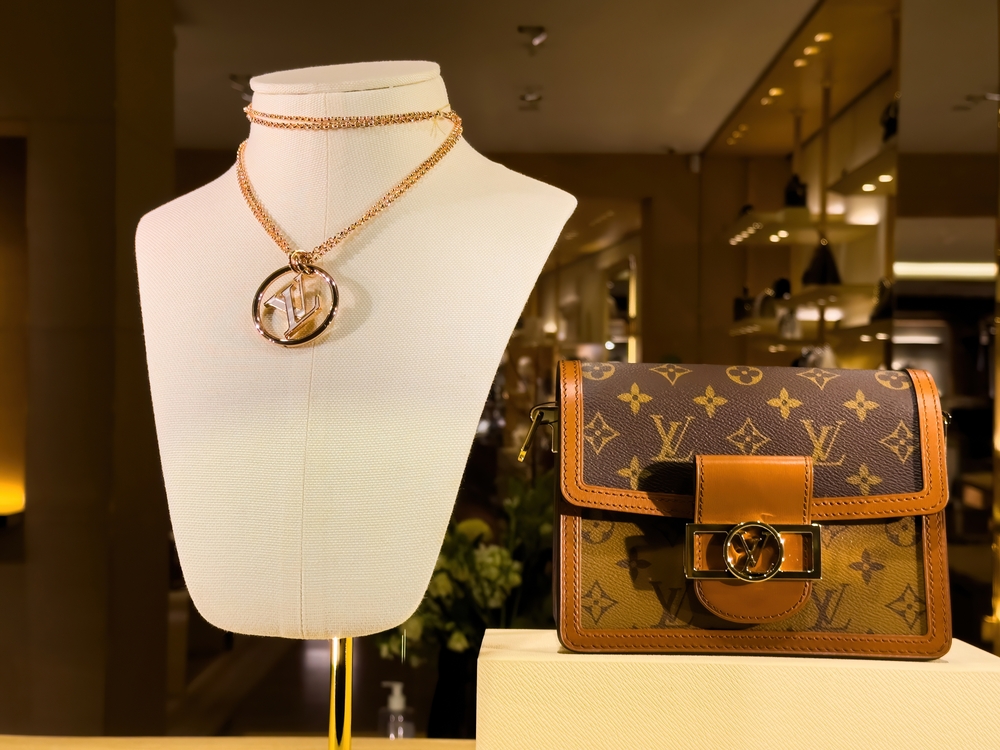
We review the size and shape of logos, charms, links, bands, settings, pendants, and negative spaces. A counterfeit can copy the central LV or Monogram Flower while missing the proportions that connect it to the chain, clasp, or surrounding design.
Straight-on and side photos help show thickness and depth. Measurements are especially useful for small pieces that can look larger or smaller depending on camera distance.
Metal surface and decorative finish
The expected finish may be polished, brushed, plated, antiqued, enamelled, crystal-set, or combined with leather, canvas, resin, or textile. We compare color, surface, edge quality, transitions, and how decorative materials are fitted.
Scratches, tarnish, plating loss, and skin-contact wear can appear on authentic fashion jewelry. Condition does not create authenticity, so the original geometry and construction still need to fit the model.
Clasps, hinges, links, and attachments
Functional components can reveal how a piece was made. We inspect lobster clasps, spring rings, hooks, pins, hinges, earring posts, backs, chain links, jump rings, and attachment points for shape, movement, finishing, and compatibility.
Our Louis Vuitton hardware page explains why a metal piece should not be judged by weight or color alone. Small construction details and connections often provide more useful evidence.
Engravings and markings
Depending on the model, markings may appear on clasps, plaques, charm backs, inner bands, posts, or other compact surfaces. We compare wording, logo form, font, spacing, depth, alignment, and placement.
Our stamps and fonts resource gives broader context on typography. A copied product code or “Made in” marking still needs to match the jewelry design and finish shown.
Stones, enamel, and special components
We inspect setting style, spacing, alignment, surface quality, color consistency, edge finishing, and attachment. A missing stone or chipped enamel may reflect wear, but sloppy construction beneath the damage can still be visible.
High-value fine jewelry may require information beyond a standard fashion-jewelry photo set. Send full images before payment if the material, value, or documentation creates a question about the available service.
Packaging and receipts are supporting context
Jewelry boxes, pouches, care cards, and receipts are removable and can be paired with another piece. The item itself must support the verdict through model, construction, finish, markings, and components.
Include those materials only after photographing the jewelry completely. A box should never be used to cover missing clasp, reverse, or engraving photos.
Photos needed for jewelry authentication
Follow our Photo Guidelines and use a plain background with soft, even light. Include the full front and back, both sides, clasp open and closed, every link or segment, attachment rings, inner surfaces, engravings, codes, earring posts and backs, stones or enamel, measurements, and all areas of wear or repair.
Use macro focus if available, but do not sharpen or edit the image until edges look artificial. Several clear angles are better than a single extreme close-up that removes the piece from context.
Common jewelry authentication mistakes
Buyers may assume substantial weight proves quality, but counterfeit pieces can be made heavy. Others rely on a stamped logo even though engravings and codes can be copied.
The conclusion needs to come from the complete design. Our About Us page explains why our team focuses only on Louis Vuitton and applies brand-specific comparison to accessories.
Buying pre-owned Louis Vuitton jewelry
Ask for the clasp, reverse, inner surfaces, and all markings before payment. Sellers should disclose missing stones, repaired links, replaced earring backs, shortened chains, plating work, or parts that came from another piece.
Confirm measurements and save the listing because small jewelry can look very different at different camera distances. The original description may be useful if the size, finish, or included components change after delivery.
Start with the exact jewelry category and reference
Louis Vuitton jewelry includes bracelets, necklaces, earrings, rings, brooches, and other decorative pieces made in many materials and constructions. A chain bracelet cannot be evaluated by applying rules from a hinged bangle, and a runway design may not share the markings of a permanent collection. The likely model, size, finish, colorway, and period must be established first.
Similar motifs may return in later seasons with different proportions or clasps. We compare the submitted item with the claimed configuration rather than assuming every LV flower, padlock, or monogram component is interchangeable. Correct identification gives meaning to the engravings, link sequence, hardware, and decorative finish that follow.
Weight is not a reliable authenticity test
A substantial feel can come from base metal, construction, dimensions, and plating, none of which proves authorship by itself. Authentic pieces also vary widely in weight because a delicate earring and a thick chain serve different designs. Online claims that genuine jewelry must feel heavy reduce a complex object to an unreliable shortcut.
We use proportions and construction more carefully. The thickness of links, balance of a pendant, relationship between clasp and chain, and finishing of hidden surfaces should make sense for the reference. Weight may be recorded as supporting context, but it cannot correct an inaccurate model or poorly constructed component.
Functional parts often carry the most useful evidence
Clasps, hinges, pins, posts, backs, jump rings, and connecting loops reveal how the jewelry was engineered. We examine their shape, movement, alignment, attachment, and finish, including the less polished sides that are not intended to face outward. A counterfeit may focus on the decorative front while simplifying these working components.
Open and close mechanisms only as they are designed to operate, and never force a stiff hinge for a photograph. Show the component in its resting and normal open position, then photograph any gap, looseness, or repair. Functional damage affects condition, but the underlying design may still provide meaningful authentication evidence.
Engravings must belong to the surface and scale
Brand wording, country information, size marks, material references, or product codes may appear in different locations depending on the piece. We examine letter form, spacing, depth, alignment, and how the mark was applied to that particular surface. An engraving on a small curved clasp should not be judged by the same visual expectation as a stamp on a broad flat plate.
Tiny marks are difficult to photograph, so poor focus can make correct typography appear irregular. Stabilize the item and camera, use diffused light, and take both an orientation image and a close view. A searchable code remains only one clue because counterfeit pieces can repeat numbers taken from authentic examples.
Surface wear should follow how the jewelry is used
Plated and polished surfaces can scratch, soften, or lose finish at high-contact points. A bracelet may show wear near its clasp and underside, while earrings may remain protected on the front but show changes at posts or backs. We compare the distribution of wear with the construction instead of treating any color change as a verdict.
Uneven aging can also result from storage, skin chemistry, cleaning, or replacement components. Describe polishing, replating, resizing, soldering, and other known work before review. Restoration may be completely practical, yet it can cover original surfaces or alter marks that would otherwise help authenticate the piece.
Enamel, stones, and decorative inserts need a complete comparison
Color, shape, setting, spacing, surface, and attachment all matter when a design includes enamel, crystals, stones, resin, leather, or other inserts. We look for consistency with the specific model and for clean integration with the surrounding metal. One attractive color is not enough if the decorative components have incorrect proportions or settings.
Missing or replaced elements should be disclosed and photographed closely. A repair can change value and completeness while leaving other original parts reviewable. If glue, solder, or a new setting covers the connection, the limitation should be considered in the final opinion rather than ignored.
Photograph every side, including the parts rarely worn outward
Start with the complete item laid out in its natural shape, then show front, back, sides, and edges. Photograph every link sequence, clasp, hinge, ring, pin, post, earring back, charm, pendant reverse, engraving, decorative insert, and damaged or repaired area. For a pair of earrings, document both items instead of assuming they are identical.
Use a plain background and diffused light that shows the metal without turning it into a blank reflection. Dark velvet may look luxurious in a listing but can hide edges and change the perceived finish. Clear evidence is more valuable for authentication than styling, and the polished sales images can be taken separately.
Buying pre-owned jewelry with fewer surprises
Confirm the exact piece, size, full length where relevant, closure type, missing elements, and repair history before payment. Ask whether paired items have remained together and whether any backs, chains, or clasps were replaced. Removable components can be mixed, so every included piece should be shown in the listing.
Save the seller’s images and inspect the item promptly after delivery. Compare engravings, link order, clasp, finish, and condition while a return is still possible. An authentication opinion is most actionable when the submitted jewelry and the represented jewelry can still be matched to a documented transaction.
What a professional jewelry review can address
Our review evaluates whether the Louis Vuitton jewelry shown is consistent with the identified model, materials, construction, markings, and period. It does not replace a gemological test, precious-metal assay, condition report, or repair estimate. Those questions may matter to value, but they are distinct from brand authentication.
Complete photographs allow the piece to be evaluated as a system rather than as a collection of logos. If tiny marks are unreadable or a clasp cannot be seen, additional images may be requested. A well-organized submission supports a clearer result for a buyer, reseller, collector, or consignment business.
Submit Louis Vuitton jewelry for review
Ask a seller for the reverse side and clasp markings before paying, since those areas are often missing from listings. Select the appropriate option on our Services & Pricing page and send a complete set for review.
Does every LV jewelry piece have a serial number?
No, marking formats vary by model, material, and release. A lack of a unique number does not establish a verdict, and a copied number does not prove authenticity.
Can worn plating mean the jewelry is fake?
No, fashion-jewelry finishes can wear with friction, moisture, cosmetics, and use. Experts compare the remaining finish and original construction with the stated model.
Is a bag charm reviewed like jewelry?
There is overlap in metal and enamel checks, but bag charms use different clasps, chains, scale, and attachment needs. Read our Bag Charm authentication post for those checkpoints.
Louis Vuitton Authentication made easy!
You are unsure if you are looking at an authentic or fake LV? We offer the quickest and the most accurate way to get it authenticated for your peace of mind.
Authenticate Now