Louis Vuitton OnTheGo authentication requires an exact comparison of the tote’s size, material, motif scale, handle system, interior, and production period. The OnTheGo has been released in several sizes and finishes, so a detail from a Monogram canvas MM cannot automatically be applied to an Empreinte PM or a seasonal edition.
Our team authenticates Louis Vuitton only and works with newer microchipped items as well as earlier production. If you need a professional review, choose from our authentication services and gather clear images of the complete tote.
Identify the OnTheGo size and material
The OnTheGo family includes several proportions, from compact versions to large work and travel totes. Classic Giant Monogram examples may combine standard Monogram and Monogram Reverse treatments, while leather versions can use embossed, printed, or bicolor Monogram Empreinte.
Each combination changes what experts expect to see in the motif, trim, lining, handles, strap configuration, and hardware. We begin by confirming the stated model rather than judging the bag against the first OnTheGo photo found online.
What we review during OnTheGo authentication
Shape, dimensions, and structure
The OnTheGo has a boxy profile with a broad opening, structured sides, and a base designed to support a roomy interior. We compare height, width, depth, side-panel angle, base shape, handle position, and the way the upper edges meet at the corners.
Replica totes may look convincing when filled for listing photos, then lose the expected balance when shown empty. Front, side, base, and overhead images help us see the underlying construction.
Giant Monogram and Reverse canvas
On canvas versions, the enlarged motifs create obvious focal points, but they still need model-specific interpretation. We examine scale, color, surface finish, placement across panels, side treatment, and transitions at seams.
A cropped or reversed motif is not automatically a problem. The question is if the placement matches the stated OnTheGo version and works with its actual construction.
Empreinte and other leather versions
Leather OnTheGo bags require comparison of grain, embossing, print, structure, edge finishing, and the way the material folds around corners and handle attachments. Embossing depth can vary with color, finish, use, and production, so a very deep or light impression does not create a verdict on its own.
The site’s canvas and leather resource gives more context on material-specific evaluation. We also compare the leather with the lining, glazing, stitching, and hardware expected for the exact edition.
Two handle lengths and their attachments
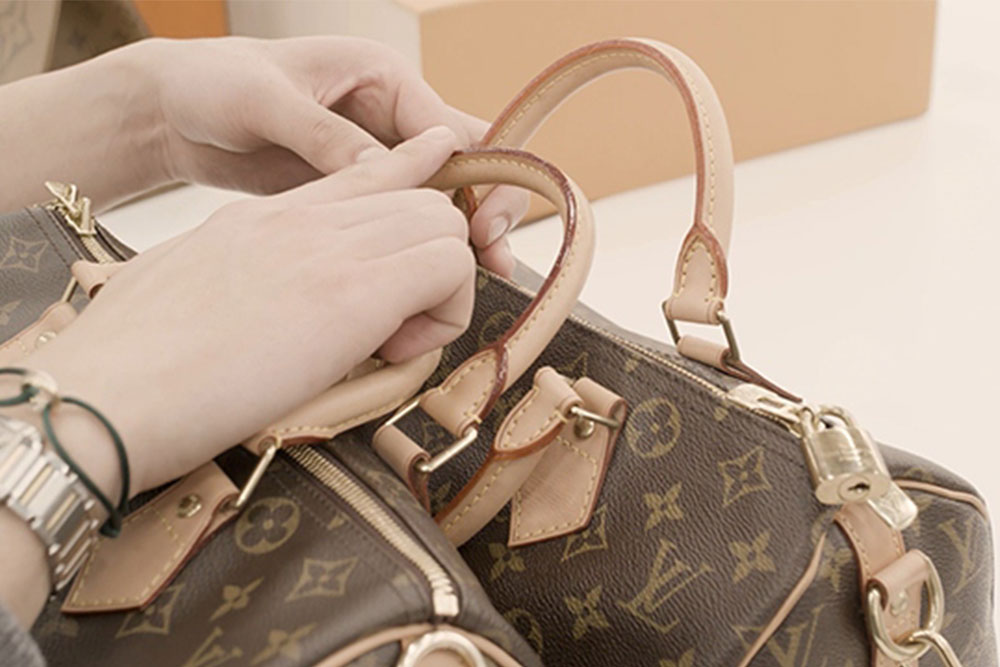
Many OnTheGo versions include short top handles and longer shoulder handles, while smaller or special configurations may use a different carry system. We review the number of handles, their length, curve, material, attachment method, stitching, glazing, and reinforcement.
Handle placement is useful because it connects to the tote’s proportions and interior construction. A counterfeit may reproduce the visible handle shape but miss the spacing or reinforcement hidden just inside the opening.
Interior, pockets, stamp, and hardware
The lining, pockets, tabs, attachment points, hook or closure details, heat stamp, and hardware should form the expected interior for the model. We look at seam finishing and pocket geometry as closely as exterior branding.
Metal components are compared for shape, finish, engraving, edges, and attachment. Color differences in photographs can come from light or editing, so a warm or pale tone is not enough to label an item authentic or fake.
Microchip-era production
The OnTheGo is frequently submitted as a newer bag, which means owners may expect a visible date code that is no longer part of the same production system. Our microchip authentication page explains why embedded identification changed the information available to consumers.
A phone reading or seller screenshot does not authenticate the physical tote. We still compare all visible construction and model details, and we request the usual identifier area because certain newer items may retain details that are useful to the review.
How OnTheGo sizes change the visual balance
The OnTheGo family includes compact, medium, and larger tote proportions, along with seasonal interpretations. Handle length, side depth, motif scale, pocket size, and base structure need to be judged against the stated version. A close front photo can make two sizes look similar, especially when the seller has not included a familiar object or measurement for scale.
We ask for the bag empty, standing naturally, and photographed from the front, side, and above. These views show if the opening, corners, handles, and base have the expected relationship. Measurements are useful support, but the construction around them still needs to match.
Long handles must connect to the interior correctly
The OnTheGo’s shoulder-carry system is not just an extra pair of straps attached at the opening. Their placement, reinforcement, length, material, and interior connection form part of the bag’s architecture. Counterfeit versions may reproduce the visible straps while simplifying the attachment beneath the upper edge.
Photograph each handle from end to end, then include close images of the points where it meets the bag. If a small or special version uses a different carry system, show every removable strap and attachment separately so it can be compared with that configuration.
Reading Giant Monogram without relying on one motif
The enlarged pattern attracts attention, and sellers often present one centered logo as evidence. We examine the entire arrangement across the front, back, sides, and seams. Scale, color relationships, cropping, reverse treatment, and the way the print follows the tote’s panel construction all need to fit the model.
Photo editing can change the contrast between Monogram and Reverse canvas. It can also sharpen edges or deepen brown and tan tones. Original images in neutral light give us better information about surface, print, and texture than screenshots copied from a marketplace listing.
Pattern placement and construction must agree
A motif can appear correctly positioned on the front while the side panels, top corners, or base show an incompatible layout. We connect pattern analysis with stitching, folds, glazing, and handle placement. This approach prevents one attractive crop from carrying too much weight.
Seasonal prints may intentionally disrupt the classic arrangement. We first confirm the collection or design before applying pattern expectations, then review the remaining construction and production details for the same release.
OnTheGo leather needs a different review
Empreinte and other leather versions cannot be authenticated by applying canvas rules. We compare leather grain, embossing or print, thickness, structure, stitch placement, glazing, lining, and the response of the material around corners and handles. Natural variation is possible, but the panels should still look like parts of the same bag.
Embossing may appear deeper in shadows or shallower under direct light. Use angled photos as well as straight-on views so the motif depth and leather surface can be seen without harsh glare. A single flattened image may hide both grain and construction.
Edge coating connects several checkpoints
Glazing appears around handles, panels, pockets, and other finished edges. We compare its thickness, color, consistency, and relationship to the leather and stitching. Wear or repair may change one area, so edge coating is reviewed across several locations before it contributes to the conclusion.
Fresh reglazing can make a used bag look cleaner, but it may also cover original edges. If the work is known, state where it was completed and include close images of the transition into untouched areas.
Microchip claims and phone scans
Buyers sometimes expect a phone to display a name, serial number, or public ownership record for a newer Louis Vuitton bag. That is not a reliable consumer authentication method. A phone response can be misunderstood, copied into a screenshot, or associated with a separate tag near the item rather than the tote itself.
We do not accept a scan as a replacement for photographs of the physical bag. The OnTheGo still needs the correct model construction, material, typography, hardware, lining, and production context. If a seller refuses to provide those images while emphasizing a scan, the buyer has not received enough evidence for a careful decision.
Condition and repairs on an OnTheGo
Large totes can soften, crease at the sides, rub at the corners, and show pressure around the handles. Interior marks and base sag may reflect normal use. We separate these condition issues from incorrect panel construction, material, or hardware.
Repairs to handles, glazing, corners, lining, or hardware should be disclosed. A repaired authentic tote may show materials from a later period, while a counterfeit can be selectively refinished to hide weak areas. Photos of both the repaired location and nearby original construction help us understand the difference.
Buying an OnTheGo from a resale listing
Ask the seller to empty the tote and photograph it without inserts or stuffing. Request the open interior, base, side panels, all handles, pockets, stamp, identifier area, hardware, glazing, and close views of the material. Styled photos can support a listing, but they should not replace plain images that show the bag’s full construction.
Confirm the exact size, material, colorway, purchase period, accessories, and repairs in writing. Save those details until the review is complete. If the received bag differs from the listing, document the mismatch before a return deadline passes.
Authentication is separate from condition and price
An authentic OnTheGo may show corner wear, softened structure, interior stains, or handle damage that affects its value. A clean replica may hold a sharp shape and arrive with convincing packaging. Origin must be evaluated separately from how new, expensive, or complete the item appears.
The professional review addresses the visible evidence in the submitted bag and components. It does not confirm a seller’s story or guarantee future resale value, so buyers should still assess condition, transaction terms, and return protection before payment.
Photos to submit for an OnTheGo
Use the site’s Photo Guidelines and send original, unedited images. Include the full front, back, both sides, base, corners, open interior, lining, all pockets, heat stamp, identifier area, short and long handles, attachments, closure hardware, engravings, glazing, and close views of the motifs.
If the bag has a removable strap, pouch, charm, or special-edition component, photograph each piece separately. A full set prevents the strongest exterior view from hiding a mismatch elsewhere.
Common OnTheGo self-check errors
The largest error is comparing different sizes or materials as if they use identical placement. Another is assuming that a microchip scan proves the tote is authentic, even though the item itself still needs expert review.
Owners may also worry because a large tote softens with use or because Giant Monogram placement looks unusual near a seam. Condition and design scale need context, and neither should be read as a stand-alone sign.
Get a professional OnTheGo review
The OnTheGo combines a simple tote shape with high-visibility motifs and multiple components, which makes complete photos essential. Select a service through our Services & Pricing page and send every requested angle before a return or claim deadline passes.
Does every OnTheGo have Giant Monogram canvas?
No, the model appears in several canvases, leathers, motif treatments, and seasonal designs. Authentication begins by identifying the exact material, size, and edition.
Can an OnTheGo be authentic without a visible date code?
Yes, newer production may use embedded identification instead of older visible date-code formats. The bag still needs a full construction and material review.
Is OnTheGo authentication the same as Neverfull authentication?
No, both are totes, but their structures, handles, interiors, and pattern treatments differ. See our Neverfull authentication post for that model’s specific checkpoints.
Louis Vuitton Authentication made easy!
You are unsure if you are looking at an authentic or fake LV? We offer the quickest and the most accurate way to get it authenticated for your peace of mind.
Authenticate Now