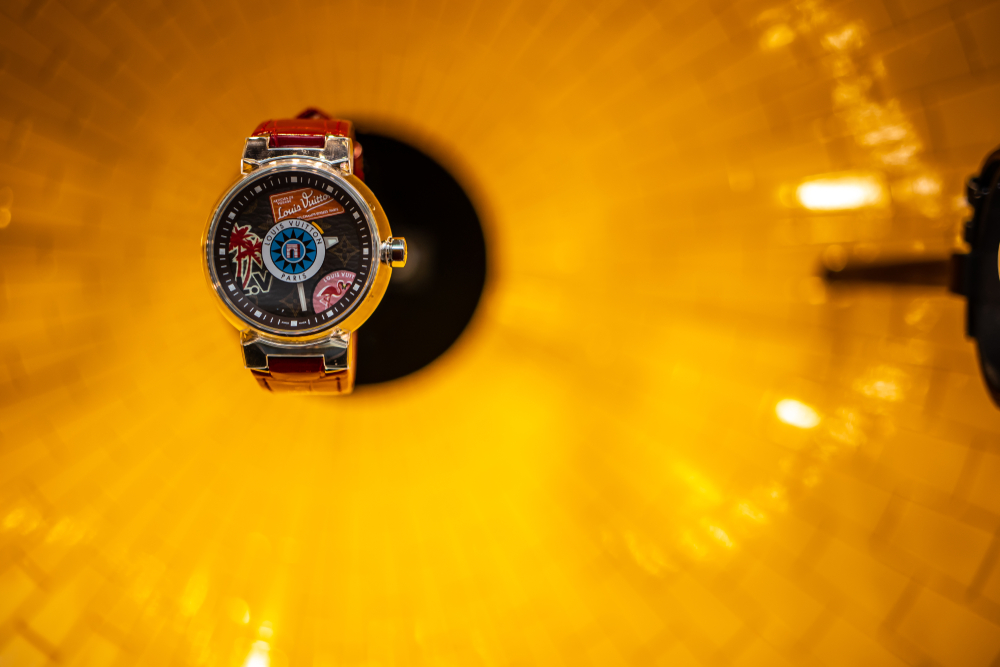
Louis Vuitton watch authentication starts with the exact model or reference and a complete view of the case, dial, crown, crystal, strap or bracelet, clasp, caseback, and markings. A logo on the dial or a matching box cannot establish the authenticity of the watch.
ProAuthenticators includes Louis Vuitton watches within our accessory scope and completes authentication from clear photos. Review our service options and send images first if the watch’s value, condition, or replaced components may require additional information.
Identify the watch before comparing it
Louis Vuitton has produced watches with different case shapes, movements, displays, complications, materials, straps, bracelets, and collection details. Several references may share a recognizable design while differing in dial layout, crown, pushers, dimensions, or caseback.
Authentication begins with the stated collection, model, size, material, colorway, and reference information. We compare all visible components with a compatible version instead of applying general watch rules to every LV timepiece.
What experts examine on a Louis Vuitton watch
Case shape and finishing
We compare the case dimensions, profile, lugs, bezel, crystal fit, surfaces, transitions, screws, and finishing. Polished, brushed, coated, ceramic, steel, gold, or mixed-material cases each create different expectations.
Close side photos reveal case thickness and component relationships that a straight dial image cannot show. Damage and refinishing may soften edges or alter surfaces, so condition history should be disclosed.
Dial, hands, markers, and date display
The dial layout should match the exact model, including logo placement, typography, subdials, hour markers, minute track, date window, hands, lume, and decorative elements. We compare spacing and alignment while allowing for camera angle and crystal distortion.
A copied dial can look convincing in a low-resolution photo. Sharp, straight-on images and angled views are needed to show print, depth, applied elements, and how the hands sit above the dial.
Crown, pushers, and functional components
The crown’s shape, logo, guards, stem position, and finish must fit the case. Chronograph pushers, correctors, rotating elements, or connected functions also need the expected geometry and placement.
We do not ask clients to force a function or open a case. Photos can show visible components and reported operation, while the verdict remains limited to what the submitted evidence supports.
Strap, bracelet, and clasp
Leather, rubber, textile, or metal carry components need the correct width, taper, material, stitching, holes, links, end pieces, buckle, and clasp. Replacements are common, so an aftermarket strap should be disclosed instead of treated as original.
Our Louis Vuitton hardware resource explains the broader value of shape, engraving, and attachment. For watches, the clasp interior and end connections are especially useful photo areas.
Caseback, reference, and engravings
The caseback may contain model, reference, material, water-resistance, manufacturing, or individual information depending on the watch. We compare wording, typography, layout, depth, alignment, fasteners, and surface finishing.
A reference copied from an authentic watch is not proof. It must describe the case, dial, strap, clasp, and configuration shown in the complete submission.
Boxes, papers, and service history
Packaging, booklets, warranty materials, and receipts can add context, but they are removable. A genuine card or box can be paired with another watch, while an authentic watch may no longer have its original set.
Service work can replace straps, crowns, crystals, hands, dials, or internal components. Provide any service documents and state known replacements so the visible watch can be assessed accurately.
Photos needed for watch authentication
Follow our Photo Guidelines and photograph the watch in diffused light without filters. Include the full dial straight on, dial at several angles, both case sides, top and bottom, crown, pushers, lugs, caseback, every engraving, strap front and back, bracelet links, end connections, buckle or clasp open and closed, reference markings, and all damage or replaced parts.
Set the watch on a soft plain surface and avoid reflections that block the dial. Do not open the caseback unless it is already open through qualified service and can be photographed safely.
Choose documentation that fits the need
A verbal opinion may fit a personal purchase, while a sale, claim, or high-value record may need formal documentation. Our page on detailed certificates explains how the available report types support different situations.
Our About Us page also confirms that watches are included among the Louis Vuitton items we authenticate. Contact the team before paying if the watch has extensive alterations or an unusual configuration.
Buying a pre-owned LV watch
Ask for a recent timestamped photo and a clear video of normal operation in addition to the still images needed for authentication. The seller should disclose service history, water damage, refinishing, replaced crystals, dials, hands, crowns, straps, or bracelet links.
Authentication addresses the submitted evidence and should not be confused with a mechanical service inspection. A qualified watchmaker may still be needed to evaluate accuracy, water resistance, or internal condition before regular wear.
Begin with the watch family and exact configuration
Louis Vuitton watches span different case shapes, dial layouts, complications, strap systems, movements, and production periods. A Tambour configuration, for example, should not be compared with a different family simply because both display familiar branding. The likely reference, size, dial color, case material, strap or bracelet, and period create the framework for the review.
Model names in resale listings are sometimes shortened or applied loosely. We verify the identity through proportions and visible features before interpreting reference information. This prevents a genuine-looking number from steering the assessment toward the wrong dial, caseback, or strap configuration.
Case geometry is easier to read from multiple planes
The face of a watch receives most of the attention, but case construction is three-dimensional. We compare diameter or width, profile, lug shape, bezel, crystal relationship, crown position, pushers where present, and the transitions between polished and brushed surfaces. Straight-on, side, top, and underside views are all needed to understand those relationships.
Polishing can soften edges and change the appearance of an authentic case. Deep scratches, dents, or refinishing should be documented as condition and service history, not automatically treated as authentication evidence. Protected areas between lugs or near the caseback may preserve sharper original finishing than exposed surfaces.
The dial must be evaluated as a complete layout
We examine the relationship among the logo, hour markers, minute track, subdials, date window, hands, and any printed wording. Spacing, scale, alignment, surface texture, and color should fit the exact reference. A counterfeit dial may reproduce each element individually but position them incorrectly within the available space.
Crystal reflections can create false alignment problems, so photos should be taken straight on as well as at a slight angle. If the crystal is scratched or has an anti-reflective treatment, provide several views in diffused light. Do not digitally sharpen the dial, since processing can change the edges of fine printing and make an accurate comparison harder.
Crowns, pushers, and functions provide supporting evidence
Crown shape, end detail, guards, pushers, and their relationship to the case vary by model. We inspect size, finishing, engraving, alignment, and normal operation when that can be shown safely. Functional behavior can support the model identification, but a working watch is not automatically authentic and a stopped watch is not automatically counterfeit.
Do not force a crown, change the date near an unknown movement’s restricted period, or operate a damaged pusher for authentication photos. State which functions are known to work and which have not been tested. Mechanical condition may require a watchmaker, while our authentication review focuses on visible Louis Vuitton evidence.
Straps, bracelets, and clasps may have separate histories
Leather, rubber, textile, and metal attachments require different comparisons. We examine dimensions, texture, stitching or link construction, fittings, quick-release elements where present, buckle or clasp, markings, and the way the attachment meets the case. Wear at holes, keeper loops, and the underside can be normal even when the case looks relatively clean.
An aftermarket strap can be fitted to an authentic watch for comfort or replacement. It affects completeness and may remove Louis Vuitton evidence, but it does not by itself determine the case and watch head. Submit the original strap or clasp if available, and identify any parts known to be replaced.
Caseback information must agree with the watch above it
The caseback may include logos, reference details, individual numbers, material information, water-resistance wording, or other marks depending on the model. We compare typography, layout, engraving method, surface finish, fasteners, and placement with the visible configuration. A copied reference cannot rescue a dial or case that does not correspond to it.
Photograph the entire caseback first, then provide clear close views of every mark and screw or fitting. Do not open the case for our photo review. Opening a watch without the right equipment can damage seals, scratch the case, expose the movement to contamination, and create a service issue unrelated to authentication.
Service parts and maintenance require careful disclosure
Watches may receive replacement straps, buckles, crystals, crowns, dials, hands, batteries, movement components, or case refinishing during their lives. Some service work preserves function while changing original evidence. A receipt can help explain the history, but the current watch still needs to be assessed as submitted.
List known work and photograph service documentation with personal information concealed. If the seller claims a recent Louis Vuitton service, confirm that the document identifies the same watch. Undocumented replacement parts create uncertainty that should be acknowledged rather than assumed original or counterfeit.
Boxes and papers cannot authenticate the watch by themselves
Warranty cards, booklets, boxes, and service pouches can be separated from one watch and paired with another. We compare any identifying information with the submitted reference, but packaging remains supporting context. The case, dial, hardware, attachments, and markings must stand on their own evidence.
A complete set can affect desirability and value, which is a separate consideration from authenticity. Photograph every included piece if it is part of the sale, but organize those images after the complete watch views. This keeps removable accessories from distracting from the object being authenticated.
A safer photo workflow for watches
Clean only loose surface dust with an appropriate soft cloth and avoid aggressive polishing. Photograph the full dial straight on, case from every side, crown and pushers, lugs, crystal edge, complete caseback, strap or bracelet front and reverse, clasp or buckle, markings, and all damage or repaired areas. Add a wrist-free profile so case thickness and lug shape remain visible.
Use diffused light and move reflections away from the details rather than using direct flash. Macro photographs should follow orientation views so each close-up can be located. If a mark is too small for the phone to focus, support the device or use its optical macro capability instead of enlarging a blurred screenshot.
What a professional LV watch review covers
Our photo-based authentication evaluates the visible Louis Vuitton design, construction, markings, and configuration. It is not a movement service, timekeeping test, pressure test, battery assessment, or valuation, and it does not require opening the case. A watchmaker may be needed for mechanical condition or water resistance.
For purchase or dispute purposes, the type of documentation matters. A basic result may answer a straightforward buying question, while a detailed certificate can be more suitable when reasoning or formal evidence is required. Choose the service based on how the result will be used, and submit the complete visible watch from the beginning.
Submit an LV watch for review
Watch listings often show the dial and box but omit the caseback, clasp, and reference details. Request those photos, then choose the appropriate option on our Services & Pricing page and submit the complete visible watch.
Does a matching box and warranty card prove an LV watch is authentic?
No, packaging and papers can be moved between items or copied. The watch and its components must support the conclusion.
Can a watch be authenticated with an aftermarket strap?
It may still be reviewable if enough original case, dial, caseback, and marking details remain. State that the strap is aftermarket so it is not evaluated as an original Louis Vuitton component.
Is a watch reviewed like Louis Vuitton jewelry?
Both require close metal and engraving photos, but a watch adds case, dial, crown, reference, and timekeeping components. See our jewelry authentication post for wearable non-watch items.
Louis Vuitton Authentication made easy!
You are unsure if you are looking at an authentic or fake LV? We offer the quickest and the most accurate way to get it authenticated for your peace of mind.
Authenticate Now